

Table of Contents
Nigeria’s oil industry is notoriously male dominated. From the Ministry of Petroleum Resources down to the seismic survey crews, it has always been men calling the shots. Women have risen in the downstream and service spaces—trading cargoes, running depots, managing logistics—but in upstream? Almost unheard of.
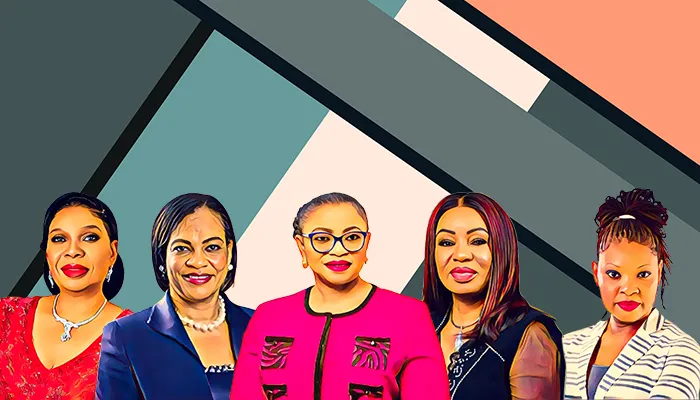
And yet, a handful of women have quietly broken through in the hardest part of the game: exploration and production. They are not middle players. They are block owners. Their companies sit on oil mining leases and production sharing contracts. Their names appear on licenses covering fields that are being drilled, tested, and in some cases already flowing barrels.
Billionaires.Africa profiles these women, today. Together, they represent a generational shift—women writing themselves into Nigeria’s most elite oil story, where technical risk is high, capital requirements are punishing, and failure is usually just one dry well away.
Daisy Danjuma
Chairman, South Atlantic Petroleum (SAPETRO)
Daisy Danjuma, a former senator and one of Nigeria’s most visible boardroom figures, is the Executive Chairman of South Atlantic Petroleum, better known as SAPETRO. The company sits on deepwater assets that have been anything but easy wins. Its landmark asset, OPL 246—later converted to OML 130—hosts the Akpo and Egina fields, developed in partnership with oil major Total and Petrobras.
Akpo alone has proven to be one of West Africa’s most prolific condensate discoveries. The field came on stream in 2009 and has produced hundreds of thousands of barrels per day at peak. Under Danjuma’s watch, SAPETRO has maintained a rare indigenous foothold in deepwater production, where only a handful of Nigerian companies have survived the capital and technical barriers.
Her company also pushed across the border into Benin, securing Block 1 and producing from the Seme field, one of the country’s key offshore assets. Few Nigerian independents can claim to be true regional players; SAPETRO, under Danjuma, is one.
Folorunsho Alakija
Vice Chairman, Famfa Oil
Folorunsho Alakija is the billionaire matriarch of Nigeria’s indigenous oil scene. Famfa Oil, which she co-owns with her family, controls a slice of the Agbami deepwater field—once a contested block, now recognized as one of Nigeria’s largest oil reservoirs.
Famfa’s stake in OML 127 has been transformative. Agbami is not marginal—it’s a multibillion-barrel field operated by Chevron, with production that has anchored Nigeria’s deepwater portfolio for nearly two decades. To own equity in Agbami is to be in rarefied company.
Alakija has endured legal battles, disputes over signature bonuses, and the constant scrutiny of being a female billionaire in a patriarchal sector. Yet Famfa has endured. Today, beyond Nigeria, the company is spreading its wings—recently acquiring blocks in Sierra Leone, a reminder that Alakija is not done expanding her oil footprint.
Cecilia Umoren
Founder, CEO Millennium Oil & Gas
Millennium Oil & Gas is not a household name, but within Nigerian upstream circles it has weight. Founded and chaired by Cecilia Aqua Umoren, the company is active in onshore Niger Delta, where geology is messy and community relations can make or break projects.
Umoren brings a lawyer’s precision to oil. She has guided Millennium through seismic acquisition, environmental approvals, and drilling campaigns. More importantly, she has played a role in OML 141, a block tied to Emerald Energy Resources, where exploration and appraisal activity have opened up significant reserves.
Her approach is marked by discipline: tight compliance with regulations, careful engagement with host communities, and a steady hand in an industry where too many independents burn out chasing quick wins. Millennium remains a reminder that serious indigenous players are not always loud but often steady.
Olatimbo Ayinde
Founder, Dutchford Exploration & Production
At Dutchford E&P, Olatimbo Ayinde represents a younger breed of Nigerian upstream executives. With a background that straddles oil logistics, maritime operations, and trading, Ayinde has built Dutchford into a company that combines block ownership with downstream integration.
Dutchford holds rights to assets offshore Akwa Ibom State, including the Udibe field, now at appraisal stage. The company has drilled, tested, and is moving toward first oil—a crucial inflection point in any block’s lifecycle. Beyond that, Dutchford operates tank farms, runs vessels, and manages crude lifting, giving it a commercial muscle that many pure E&Ps lack.
Ayinde has cultivated a reputation for being as comfortable negotiating rig contracts as she is discussing shipping schedules. It’s a blend that gives Dutchford unusual resilience: the company can move crude from wellhead to export tanker under its own umbrella.
Uju Ifejika
Founder, Brittania-U Nigeria
No woman in Nigeria’s upstream space has been more consistently visible than Uju Catherine Ifejika. A lawyer by training, she built Brittania-U into a fully fledged E&P operator with its flagship Ajapa marginal field.
Ajapa is modest by international standards but significant by Nigerian marginal field metrics. It produces via an FPSO—a floating production, storage and offloading vessel—making Ifejika one of the very few indigenous operators to deploy and manage such a complex system. From drilling programs to crude marketing, she has overseen the full cycle.
Ifejika has also pushed Brittania-U into shipping, refining, and gas, creating a more diversified energy platform than many male-led independents. Her career stands as proof that a Nigerian woman can run not just a block but an integrated upstream operation.
Addendum —
Ayodele Dalgety Dean
Co-founder, Sispro Inc., Guyana
Though her story is not Nigerian, Ayodele Dalgety Dean belongs in the same breath as Nigeria’s oil trailblazers. Sispro Inc., a Guyana-based company she co-founded was able to secure two oil blocks following the conclusion of the International Licensing Round in 2022. Based in Guyana, she is part of a small, rare circle of women globally to hold an oil block license in her own right. And her license sits in perhaps the most exciting oil province of the 21st century: the Guyana–Suriname basin.
In less than a decade, this basin has transformed from speculative acreage into one of the world’s hottest upstream frontiers. ExxonMobil and its partners, Hess and CNOOC, have already booked more than 11 billion barrels of recoverable resources across a string of discoveries. With each appraisal well, Guyana’s name climbs further up the global league table, from oil newcomer to exploration hotspot.
Dalgety Dean’s block is part of this energy reawakening. While not yet in full production, her asset is under exploration and appraisal—a stage that involves seismic imaging, geophysical modeling, and exploratory drilling to establish commercial reserves. In industry terms, this is the riskiest and most capital-intensive point in the cycle. Wells can come up dry. Seismic can mislead. Infrastructure planning is still speculative. To hold equity at this point is to accept the sharp edge of risk in return for the possibility of transformative reward.