

Table of Contents
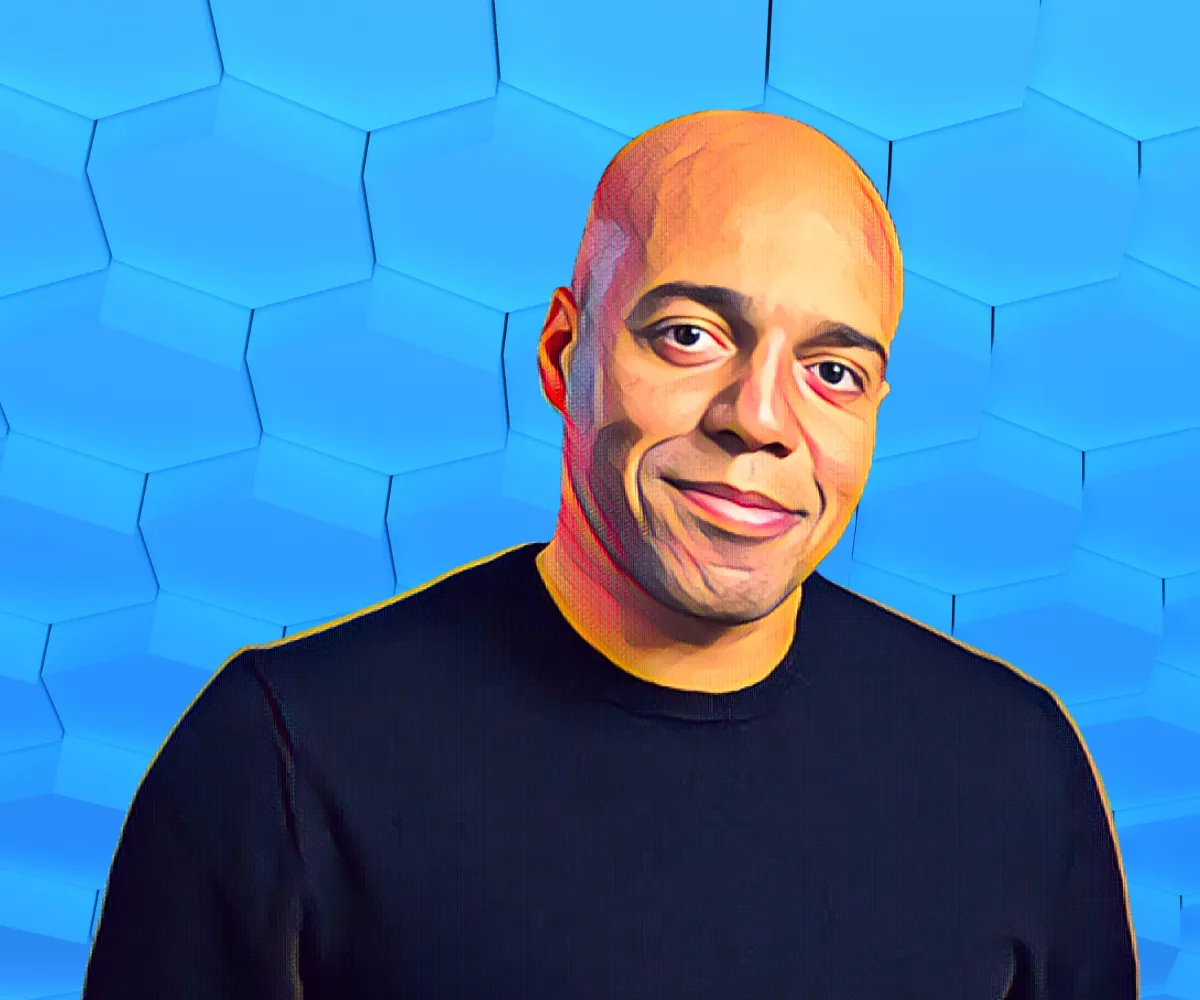
There is a version of Adeyemi Ajao's story that sounds like a straight line from Lagos to the Forbes Midas List, and it is the wrong version. The real one has more detours, more reinvention, and more deliberate strangeness than any clean arc can contain.
He was born to a Nigerian father and a Spanish mother. His first years were in Lagos. Then Italy. Then, when he was around eight or nine, southern Spain. Marbella, to be precise, one of the most insular beach resorts on the Costa del Sol, where being a Black child with an afro in the 1980s was its own daily education in what it means to be an outsider. He had no Beatles haircut. He was not interested in football the way his classmates were. He played chess. He was drawn to computers. He was, in almost every social dimension, the wrong kind of kid in the wrong kind of place.
His mother told him something early that he has carried ever since. "The best thing you can do is just fully embrace your differences and go with the flow." He did not fully believe her at the time. He came to, eventually.
The self-taught coder
Ajao taught himself to code in high school. There was no formal class that gave it to him. He just sat with computers, asked questions, figured things out. By the time he enrolled at Comillas Pontifical University's Icade faculty in Madrid to study law and economics, he was already thinking about technology not as a subject but as a medium. He came away with a joint law degree and a master's in economics. He was also thinking about building something.
In 2005, while still a student in Madrid, he co-founded Tuenti, a social network aimed at Spanish youth. This was the year Facebook was still figuring out whether to open itself beyond American college campuses. Ajao and his co-founders went after the Spanish market hard, building a local product with a local feel that understood how Spanish students actually socialized. Tuenti grew quickly. It earned the nickname "the Spanish Facebook," though Ajao would later note, with some quiet pride, that Tuenti beat Facebook in Spain before Facebook eventually caught up. In 2010, Spanish telecom giant Telefonica acquired the company for around 75 million euros, roughly $100 million at the time. Ajao was in his late twenties.
He was not done building.
McKinsey, Stanford, and the HR bet
After Tuenti, Ajao spent time at McKinsey and Company, the global consulting firm, where he got his first systematic exposure to how large organizations think about strategy. He then enrolled at Stanford Graduate School of Business, completing his MBA in 2010. Stanford would later name him an alumnus whose work on the Forbes Midas List reflected well on the school.
At Stanford and around Silicon Valley, a particular obsession was forming. Ajao had started thinking seriously about machine learning and what it could do for human capital, for the messy, analogue process of matching people to jobs. In 2014, he co-founded Identified, a company built around AI-powered professional networking and career matching. The idea was that a machine, given enough data, could understand career trajectories and connect workers with opportunities better than any recruiter doing it by hand. Workday, the enterprise software giant, agreed that the idea had merit. It acquired Identified in 2014, after the startup had raised $22.5 million.
Ajao went to work inside Workday, rising to vice president of technology product strategy. He also helped launch Workday Ventures, the company's first corporate VC fund, focused specifically on applied AI for enterprise software. It was his first sustained exposure to what it felt like to back founders rather than be one. The experience sharpened something in him.
The Base10 thesis
By 2017, Ajao had decided. He co-founded Base10 Partners with entrepreneur TJ Nahigian, and the two set up shop in San Francisco at 101 Mission Street. The thesis was not complicated, but it was deliberately contrarian. While much of Silicon Valley was chasing consumer apps, social media and enterprise SaaS, Ajao wanted to back founders building automation for what he called the Real Economy, the sectors that actually employ most people: logistics, food, retail, healthcare, construction, operations. The blue-collar world. The industries that venture capitalists tend to treat as unsexy.
"A lot of our founders are working on problems that would be considered extremely unsexy for traditional tech-focused venture capitalists," he said in an early interview. "Logistics, trucks, food procurement, waste management. They might not be the best cocktail conversation but they are the problems that if solved are going to make humanity better."
His portfolio from the early years reflected this conviction. Instacart, which rewired American grocery shopping. Nubank, the Brazilian neobank that eventually grew to a $30 billion-plus valuation and transformed financial inclusion across Latin America. Figma, the collaborative design software that Adobe tried to buy for $20 billion before regulators blocked the deal and Figma went on to pursue an IPO. Rappi, the Colombian super app that became a defining company in Latin American commerce. Notion. Stripe. Brex. The firm has realized more than $3 billion in returns across its portfolio.
Base10 raised its debut fund, then came back with Fund II at $250 million, bringing assets under management past $400 million. A third fund pushed total AUM to $1.3 billion, making Base10 the first Black-led venture capital firm to cross the $1 billion threshold in history.
The Midas List
In 2023, Forbes named Ajao to the Midas List, the annual ranking of the world's top 100 venture capitalists that media executive Kara Swisher has called "the Oscars for venture capitalists in tech." Ajao came in at number 96. The distinction mattered not for the ranking itself but for what it represented. He was the first Black investor ever named to the list in its two-decade history. He made the list again in 2024.
He does not appear to have spent much time celebrating either appearance. The work continued.
The outsider edge
What is striking about Ajao when you put his career together is how consistently he has used the experience of being an outsider as a lens rather than a liability. Growing up Black in southern Spain in the 1980s, neither fully Nigerian nor fully Spanish, prepared him to look at markets from the outside in. That perspective shaped Tuenti, which he built for a market that Facebook's American founders did not fully understand. It shaped Identified, which tried to see careers the way a machine could, stripped of the biases recruiters carry. And it shapes Base10, which deliberately invests outside Silicon Valley's usual geography, backing founders in Latin America, in Africa, in places that traditional VC still treats as peripheral.
Roughly 60 percent of Base10's portfolio companies are led by women or minority founders. The firm has also committed what it calls the Advancement Initiative, pledging 50 percent of profits from its largest fund to create scholarships at underfunded universities for underrepresented students in technology. Ajao is also a supporter of Code2040 and the Black Venture Capital Consortium, organizations that exist to build pipelines for the next generation of Black founders and investors.
"I definitely still feel like an outsider today in almost every circle," he said in a 2022 interview, years after the exits and the billion-dollar fund and the Midas List appearances. He said it without complaint. The boy from Marbella learned early that being different from the room is an informational advantage, not a deficit. He has spent his career proving his mother right.