

Table of Contents
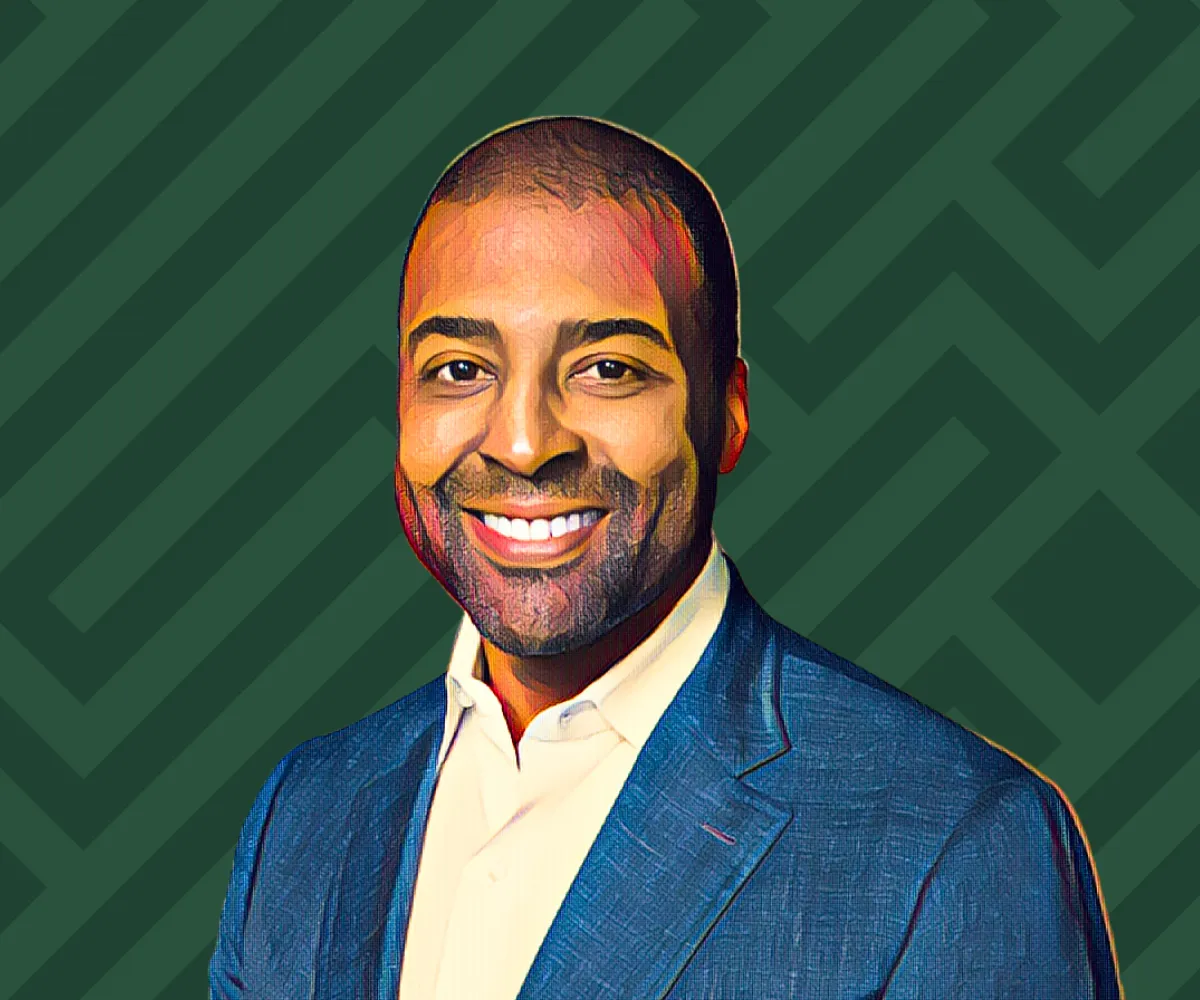
The summer Frank Baker showed up on Wall Street for the first time, he had never been to New York City.
He was a sophomore at the University of Chicago, studying economics, and had stumbled into the career center when he ran into a recruiter from Sponsors for Educational Opportunity, a nonprofit that helped young people from underrepresented communities get their first foot inside the door of corporate America. The recruiter offered Baker a summer internship at Goldman Sachs. He said yes. He got on a plane and landed in a city, and a world, he had never seen before.
"Prior to joining Goldman, I had never been to New York City. I had no concept of Wall Street or investment banking," he later said. "Landing in this competitive, exhilarating environment where economics and the real world came together was a huge inflection point in my life."
That internship, secured through a nonprofit when he was not yet 20 years old, is the hinge on which Frank Baker's entire story turns. Today he is the co-founder and managing partner of Siris Capital Group, a private equity firm he built from scratch that has now raised more than $7 billion in cumulative capital commitments. He is one of the most prominent Black investors in American finance, and he has spent the better part of two decades making sure the next generation has the same kind of break he got.
Growing up in Detroit
Baker was born in 1972 and grew up in the Detroit area, the product of a family that placed enormous weight on two things: education and entrepreneurship. His relatives were small business owners, people who dealt with landlords and banks and employees, who understood what it meant to build something with limited capital and no safety net. He watched them do it growing up. He absorbed it.
"I grew up watching my family build businesses on a small scale, dealing with people, landlords, banks, and everything else," he has said. "There was a huge family component to everything."
His parents pushed hard for his education. He attended Detroit Country Day School through his freshman year of high school, a private institution that was not easy for his family to manage financially, before transferring to a public high school in the predominantly white suburb of Bloomfield Hills. He was usually among very few Black students in the rooms he occupied. He was used to it. He kept moving.
At the University of Chicago, Baker majored in economics, played football and earned All-American and Academic All-American honors, captaining the team his senior year. He was active in the Organization of Black Students. He also graduated from the SEO programme in 1992, two years before he received his undergraduate degree. Goldman Sachs hired him into its mergers and acquisitions group on graduation.
Goldman, Harvard and four years in Tokyo
Baker spent time in Goldman's M&A group before going back to the University of Chicago for his undergraduate degree in 1994. He then enrolled at Harvard Business School, completed his MBA, and returned to work at Ripplewood Holdings, a global private equity firm. What happened next was not in the plan.
Ripplewood sent him to Tokyo. A week's assignment stretched into a month. Then six months. Then four years.
"If you thought I stood out as different before, Japan was that, but on steroids," he has said with a laugh. But the experience, as isolating as it sounds, did something important to his career. He was 13 time zones away from his colleagues, operating with significant autonomy, making decisions that would have been handed to more senior people in New York. The exposure was compressed and intense.
"I really developed personally and professionally in the four years that I lived there. Tokyo was a 13-hour flight away from anyone else in my office, so I had a great deal of autonomy and responsibility. It turbocharged my career, in a sense."
When he returned to the United States in 2005, Baker knew he was ready to start something of his own.
Building Siris, 500 meetings at a time
In 2011, Baker launched Siris Capital Group alongside Jeffrey Hendren and Peter Berger. The three had worked together at Ripplewood. They set up the firm in New York with a focused strategy: invest in mature technology and telecommunications companies that are facing industry changes or other significant transitions, companies with mission-critical products that have real operational leverage waiting to be unlocked. The idea was not to chase flashy growth-stage startups but to find deep value in overlooked or mismanaged businesses and fix them.
Raising the first fund was, by Baker's own account, a brutal exercise in persistence.
"When we were raising our first institutional fund at Siris, it went something like this: I had 500 meetings, and the first 100 people said, 'Hell, no.' The next 300 just said, 'No.' And then I finally managed to get people to kind of listen to what I was saying," he said. He kept going back to a saying his uncle was fond of, one credited to Carl Brashear, the first African American to become a US Navy Master Diver: it's not a sin to get knocked down; it's a sin to stay down.
Baker got up every time. "After we had successfully invested that first fund, the people who said 'Hell, no' when I approached them became my best investors in the next fund," he said.
Siris raised its first institutional fund, then came back with a second, then a third of $1.8 billion. The firm has raised more than $7 billion in cumulative capital across all funds. Baker sits on the board of every portfolio company. He considers that a defining feature of the firm's model, not an administrative detail. The strategy centers on driving value creation in businesses where the original investors or management did not fully understand what they had.
Giving back, systematically
Baker has not waited until retirement to give. He has been building his philanthropy in parallel with his firm, and he has been deliberately systematic about it.
The first public signal came in 2016, when he and his wife Laura Day Baker, an interior designer and philanthropist, made an $8 million gift to the University of Chicago to establish the Frank Baker and Laura Day New Leader Odyssey Fund, endowing undergraduate scholarships and internships for lower-income students with exceptional potential. The university's newest dining commons was named in their honor.
Then, in 2020, inspired in part by Robert F. Smith's Morehouse moment a year earlier, Baker paid off the remaining tuition balances of nearly 50 graduating seniors at Spelman College, the historically Black women's liberal arts college in Atlanta, through a $1 million gift. He has continued funding Spelman scholarships since. In 2022, he and Laura Day made a $1.2 million donation to Florida A&M University to establish the Frank and Laura Baker Graduation Fund, covering outstanding balances for students on track to graduate in four years.
The logic behind these gifts is not sentimental. It is structural. "We need to make sure these schools continue to be viable," he said. And the graduates who benefit, he has said plainly, are expected to pay it forward. He makes that expectation clear.
Baker also serves as chairman of Robert F. Kennedy Human Rights, a board member of Sponsors for Educational Opportunity, the same nonprofit that got him into Goldman Sachs as a sophomore, and a trustee of the University of Chicago, Spelman College and the Norton Museum of Art. He is an advisory board member of All Star Code, which works to expand access to computer science education for young men of color.
His philosophy, borrowed from a UNCF conversation he has had publicly, comes down to three words he treats as a sequence: learn, earn and return.
He learned in Detroit, in Tokyo, in Goldman's M&A rooms and in Harvard classrooms. He earned by building Siris into a firm that was not supposed to exist, raising $7 billion through 500 rejections and the stubborn conviction that the strategy was right. He is now deep into the return. And by his own account, he is only getting started.