

Table of Contents
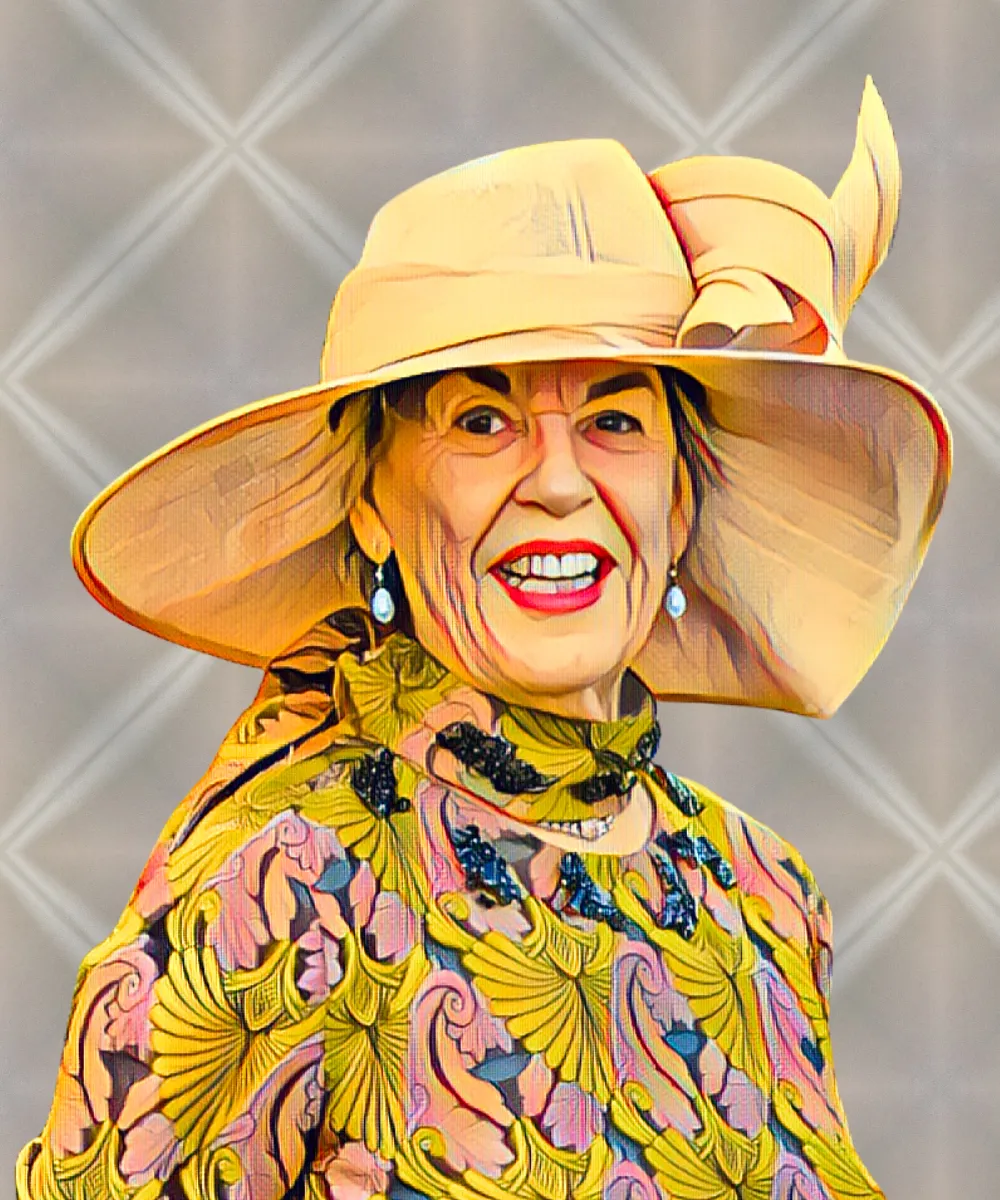
One morning in the mid-1990s, Mary Oppenheimer Slack woke up and decided she wanted her own stud farm.
That is roughly how she tells it, with a casualness that belies the scale of what she was about to build. She was already the daughter of Harry Frederick Oppenheimer, chairman of Anglo American and De Beers, and the heir to one of the largest private fortunes in African history. She had worked in arts administration, chaired charitable foundations, and moved through Johannesburg's elite cultural circles for decades. But horses were what she was really about, and she had been circling the idea of a thoroughbred breeding operation long enough. She made the call. The result, a quarter century later, is Wilgerbosdrift Stud in Piketberg, one of South Africa's most decorated breeding operations and the base from which she has pursued her life's deepest passion with the same rigour her father brought to diamonds and copper.
Born into royalty, obsessed with horses
Mary Slack, née Oppenheimer, was born in December 1943 in Johannesburg. She was the eldest of two children born to Harry Oppenheimer and his wife Bridget, a woman who would herself become one of the most beloved figures in South African racing, known affectionately as "Mrs O" and widely regarded as the first lady of the South African turf. Horse racing ran through the family like a bloodline. From the 1940s onward, the Oppenheimers raced and bred at Mauritzfontein Stud near Kimberley, a farm that would produce generations of champions and contribute foundational stallions to the South African thoroughbred register.
Mary was educated at Heathfield School in Ascot, England, where she was head girl, before studying at the Sorbonne University in Paris. The equestrian sensibility was already forming. As a young woman she competed as a show-jumper, a discipline she stayed involved in long after most would have set it aside. She has said she still had several show jumpers boarded on a farm in KwaZulu-Natal years into building Wilgerbosdrift, simply because she could not bear to part with them.
"I was always mad about horses and wouldn't know what to do with myself if I didn't have them around," she said in a profile published by trainer Mike de Kock's racing platform.
From the Sorbonne to the paddock
The road to Wilgerbosdrift was not direct. Mary built a career in the arts and cultural sector that was serious and substantial in its own right. She became a trustee of the Oppenheimer Memorial Trust in 1971, the foundation established by her father, and eventually served as its chairwoman. She was managing trustee of the Market Theatre in Johannesburg between 1989 and 1992. She co-founded Wiphold, the first women-led company listed on the Johannesburg Stock Exchange. She founded Business and Arts South Africa in 1997 and served as its inaugural chairwoman. She chaired the Brenthurst Library and Brenthurst Press, supported the South African Mzansi Ballet and raised funds for Dorkay House. She was a trustee of the Johannesburg Art Gallery and the Palaeontological Scientific Trust.
All of this was genuine and sustained, and she has kept it up alongside her racing career. But the horses were always there, pulling at her.
When she finally decided to build the stud, she searched extensively for the right property across the Cape's traditional thoroughbred areas: Robertson, Wellington, Somerset West, Paarl, Ceres. None of them felt right. She eventually found what she was looking for outside Piketberg in the Western Cape, and construction of the stables and paddocks began. The founding stock, mares and weanlings and yearlings she had boarded at Mauritzfontein, moved south to the new farm. She was off.
Building Wilgerbosdrift
From the start, Mary Slack's approach to breeding was clear and uncompromising. She was not interested in quantity. She was not particularly interested in handicaps. Her stated goal was to breed classic horses, to win the Guineas and the other top three-year-old races and to produce stallions that would leave a lasting mark on the South African stud book.
She has largely done what she set out to do.
Wilgerbosdrift received the Equus Award as South Africa's outstanding breeder in 2006, a year in which Mary also won the outstanding owner award and the Horse of the Year award. That clean sweep in a single season remains one of the industry's more extraordinary single-night results. The farm has produced stallions including Dynasty, Kildonan, Elusive Fort and Noordhoek Flyer. Dynasty, developed at Wilgerbosdrift, became a dominant presence in the South African sire rankings, himself the sire of multiple champions and continuing a bloodline that traces back to Fort Wood, the great Mauritzfontein stallion her parents stood at stud.
She sold her colts and kept her fillies, a philosophy that reflected her belief in female lines and endurance breeding. The Oppenheimer family had won the SA Oaks more than a dozen times before Mary began operating independently, and she has continued that tradition. In 2023, her filly None Other, trained by Lucky Houdalakis, won the Bridget Oppenheimer Oaks, the race 4Racing had named after her mother. The symbolism was not lost on anyone watching.
Royal Ascot and Hong Kong
The 2022 racing season was particularly striking. Her horse Sparkling Water won the Durban July Handicap, a Grade 1 race over 2200 metres at Greyville and one of the most prestigious events on the South African racing calendar. In the same year, her colt Claymore, trained by Jane Chapple-Hyam in England, won the Group 2 Hampton Court Stakes at Royal Ascot on June 16, ridden by Adam Kirby. The Royal Ascot win was a significant marker of the international reach her operation had developed.
Later that year, she and businessman Zhang Yuesheng became the first non-resident members of the Hong Kong Jockey Club, opening a channel into one of the world's most competitive racing jurisdictions. Her colours, black with a scarlet cap, have a history that pre-dates her involvement. They were registered by Jack Joel in 1900 and later gifted to her by Jim Joel, with whom she raced several horses earlier in her career. The best of those collaborations was a colt called Lightning Path, given to her by her parents, who won the South African Derby in 1969.
Saving South African racing
In 2020, Mary Slack stepped forward when South African racing needed rescuing. Phumelela Gaming and Leisure, the country's largest horse-racing company, entered business rescue during the COVID-19 pandemic after the shutdown of racing events devastated its finances. Her family office, Mary Oppenheimer Daughters, extended R100 million in post-commencement finance to stabilise the company, then provided R550 million more as part of a broader restructuring plan. The intervention, made through MODO at a time of significant commercial risk, helped save an industry and the livelihoods of thousands of people employed across South Africa's racing ecosystem.
In recognition of that contribution, she received the Lifetime Achievement Award at the Equus Awards in September 2020.
In the same year, she donated R1 billion to the Solidarity Fund during the COVID-19 pandemic, a commitment on a scale that few private individuals anywhere on the continent could match.
The inheritance and the legacy
When Harry Oppenheimer died in 2000, Mary inherited alongside her brother Nicky on an equal basis. She holds a 50:50 stake with Nicky in the family fortune, which includes the Oppenheimer family's substantial private holdings and the vast portfolio managed through De Beers and related entities. Her family office, MODO, oversees more than $3 billion in assets under management across foreign government bonds, stock market indexes and private equity funds, with operations in Johannesburg, London and the Isle of Man.
She lives at Brenthurst Estate, the Oppenheimer family compound in Parktown, Johannesburg. She also owns Vergenoeg, a historic mansion in Muizenberg designed by architect Herbert Baker and designated a national monument.
Her daughter Jessica Slack-Jell, married to trainer Steven Jell who works with Mike de Kock, now manages Mauritzfontein Stud. The two operations, Wilgerbosdrift and Mauritzfontein, have been conjoined since Bridget Oppenheimer's death in 2013, collectively maintaining a band of approximately 150 mares. The dynasty her parents built is passing to the next generation largely intact, and through her own hands and her own choices, Mary Oppenheimer Slack has made sure it is passing on stronger than she found it.