

Table of Contents
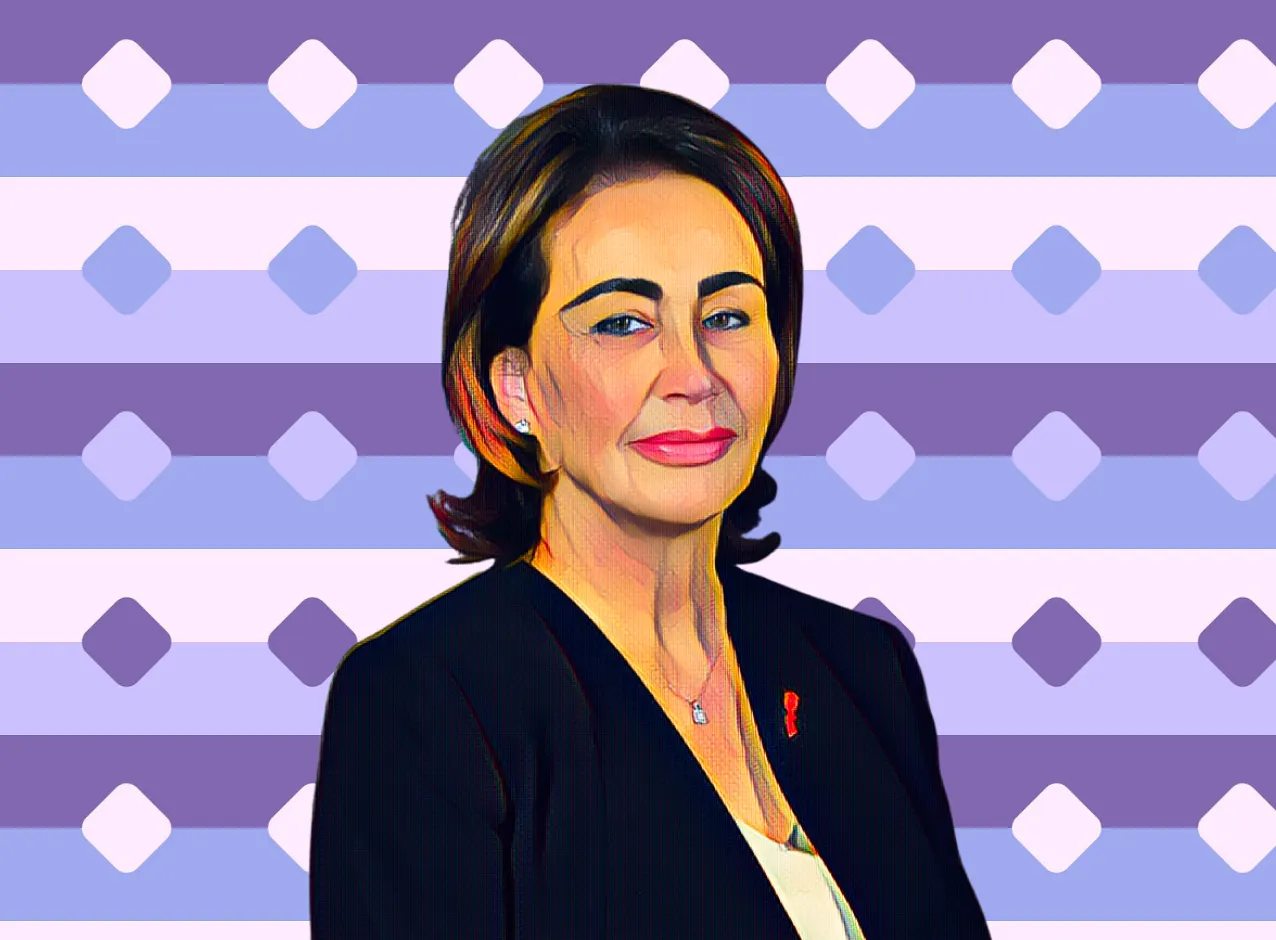
At thirteen years old, Rita Maria Zniber held the Moroccan national record in the women's long jump. She was also captain of the basketball team at Lycée Descartes, the French high school in Rabat, and she rode horses. She dreamed of becoming a lawyer or a doctor. What she became, eventually, was the chairman and chief executive of one of the largest privately owned companies in Morocco, running an empire that generates revenues exceeding MAD 4 billion (approximately $370 million to $400 million) annually, employs more than 7,000 people directly and supports 24,000 more across its supply chain.
The distance between the girl setting athletic records in Rabat and the woman who runs Diana Holding today is not a straight line. It is a life.
She was born in Morocco, the daughter of a family with deep rural roots. She spent significant portions of her childhood in the countryside, around uncles and cousins who worked in agriculture, developing an early understanding of the land that would later become professionally useful in ways she could not have anticipated. She excelled at school, at sport and at the piano. She enrolled in law at the Sorbonne in Paris. Personal circumstances interrupted those studies. At seventeen, she married, and her life as a mother began. She would eventually raise fifteen children.
Her second marriage, to Brahim Zniber in 1979, placed her at the centre of a business empire that was already substantial and still expanding. Brahim was born in 1920 in Salé, raised in Sidi Kacem, and had spent more than two decades by the time he married Rita Maria building what would become one of Morocco's defining commercial stories. He had purchased 740 hectares in Aït Harzallah in 1956 and built a winemaking business on that foundation, expanding through the 1960s and 1970s into fruit production, poultry farming and Coca-Cola bottling. By the time Brahim and Rita Maria married, Diana Holding was already a significant enterprise. By the time he died, in September 2016 at the age of 96, it was the seventh largest privately owned company in Morocco.
The company named after her daughter
Diana Holding takes its name not from a classical goddess or a geographic landmark but from Rita Maria's daughter, Diana Zniber, who today serves as a board member and the group's communications director. The naming is the clearest possible signal of how the Znibers have always run this company: as a family enterprise in the fullest sense, where the business and the family are inseparable.
Rita Maria joined Diana Holding formally in 1988, nine years after her marriage to Brahim. She was not brought in as a figurehead. She was not given a title and a corner office and asked to smile at events. She worked. She observed every aspect of the business from within, sat on the Supervisory Board and built her understanding of an agro-industrial operation that by then already spanned wine, beverages, poultry, agriculture and distribution. She served as President of the Supervisory Board before being appointed Chairman and CEO in 2014, two years before her husband's death, a structured and deliberate succession rather than an emergency assumption of power following bereavement.
She has described the relationship between the family and the business in terms that reflect decades of living inside both: "There is a correlation between the business and the family. The family fuels the business, but the business also fuels the family in a sense that the values are co-created and co-shared."
The empire she runs
Diana Holding is a privately held agro-industrial conglomerate headquartered in Morocco. Its annual revenues exceed MAD 4 billion, equivalent to approximately $370 million to $400 million at current exchange rates. In 2020, amid the full disruption of the COVID-19 crisis, the group generated consolidated revenues of $342 million. By 2022, as recovery accelerated, that figure had climbed to $441 million. The trajectory reflects a business that continued investing and expanding through the hardest commercial environment of the past generation.
The wine business is where everything started, and it remains the most internationally recognised component of Diana Holding's operations. Celliers de Meknès, the group's wine subsidiary, is the largest wine producer in Morocco, owning vineyards across more than 2,000 hectares near Meknès and producing tens of millions of bottles annually. Brahim Zniber established Morocco's first appellation d'origine contrôlée in 2005, the Coteaux de L'Atlas designation, giving Moroccan wine the same geographic identity framework that has anchored the value of French and Italian wines for centuries. The flagship Château Roslane label is now distributed across more than 30 countries, including markets in France, the United Kingdom, the United States, Canada and Belgium. Under Rita Maria's stewardship, the international distribution of Moroccan wine has deepened and broadened.
The Coca-Cola bottling franchise, which Brahim secured in the 1970s, gives Diana Holding production and distribution rights for one of the most commercially powerful beverage brands in the world across Moroccan markets. The franchise is both a stable revenue contributor and a logistical infrastructure that supports the group's broader distribution capabilities.
Poultry farming and processing, another sector Brahim entered in the 1970s, has grown into a significant domestic contributor. The group's agricultural operations extend across olive cultivation, with 1,000 hectares of olive groves producing the CaracTerre virgin olive oil brand, a product positioned for export into European and North American markets where demand for high-quality North African olive oil has been growing steadily. A storage capacity of 3,500 tonnes of olive oil gives Diana Holding substantial operational flexibility to manage seasonal production cycles and market timing for export.
Citrus production in the Berkane region in northeastern Morocco near the Algerian border is a further pillar of the group's agricultural operations. In March 2022, Diana Holding signed a $12.1 million investment agreement with Morocco's Ministry of Industry and Trade for a juice processing facility in Berkane, moving upstream from raw citrus production into the value-added processing tier where margins are substantially higher.
Sea products processing, plastics manufacturing and distribution infrastructure complete a portfolio that spans six distinct industry verticals and represents one of the most genuinely diversified food and agriculture businesses in North Africa.
Climate, drought and the next challenge
Managing a business this deeply rooted in Moroccan agricultural production means managing the consequences of climate change in real time. Morocco has been experiencing severe and sustained drought conditions, particularly in the eastern part of the country where Diana Holding's citrus operations are concentrated. The disruption to the Russia-Ukraine war supply chains hit input costs across the entire agricultural and food processing sector simultaneously.
Rita Maria has not avoided these challenges in her public statements. "Drought and climate change have affected us dramatically in these last five years, especially in the oriental part of Morocco where we have our citrus business unit," she told Gulfood in a 2023 interview. "We have to innovate in irrigation and are looking forward to the building of desalinization plants. We are also still recovering from the COVID crisis and the disruption of logistics chains as well as the Russia-Ukraine war."
The response has been structural rather than reactive. Diana Holding partnered with Mohammed VI Polytechnic University in November 2021 to work on building a more sustainable and innovative agricultural ecosystem in Morocco. The partnership connected the group with one of Africa's most prominent scientific institutions and positioned it at the leading edge of Morocco's agricultural modernisation agenda.
On the question of a public listing, Rita Maria has been characteristically direct. Asked whether an IPO might be on the cards, she responded: "Why not? We're looking for that because we have the proper governance for that." The comment was not a firm commitment but it was not a dismissal either. A group with this scale of revenues, this breadth of operations and this level of governance maturity would be a significant listing on any African or European exchange.
The philanthropist who started before she was powerful
Since May 1982, Rita Maria Zniber has run the Rita Zniber Foundation, a public utility association in Morocco dedicated to children without families. The foundation predates her formal corporate role at Diana Holding by six years. It operates Le Nid and L'Annexe du Nid care centres, providing residential care for abandoned children from birth through to adult life, supporting them through Kafala foster arrangements or through vocational education when no family is found. She is founder and Honorary President of La Main Tendue, an association that pioneered preschool education in rural Morocco. She is a member of the Mohammed V Foundation for Solidarity.
The philanthropy is not a recent addition to a successful career. It has been running for 44 years, through marriages, through the growth of the business, through the death of her husband, through a global pandemic and through the accumulation of every leadership title she now holds. She started caring for abandoned children when she had no official corporate title and no Forbes ranking. She still does it now that she has both.
The recognition and what comes next
Forbes has ranked her among the 100 most influential women in the Arab world on multiple occasions. Jeune Afrique has placed her among the most influential women in Africa. She received France's Légion d'Honneur. She won the AllAfrica Female Leadership Award. In January 2024, she received the European Women's International Leadership Award in Brussels from MEP Pierrette Herzberger-Fofana.
Her son Leyth Zniber founded Eiréné, an investment fund, in 2014. Her daughter Diana Zniber sits on the Diana Holding board and runs communications. The next generation is already inside the business, which suggests that the structured succession approach Rita Maria applied when she took over from Brahim is now being applied again, one generation later.
Diana Holding is moving toward its seventh decade of continuous operation under the Zniber family. The woman who holds the Moroccan women's long jump record from 1967 or thereabouts is still running, in every sense of the word.
The intelligence satisfies curiosity. The paid briefings satisfy strategy.
Every Monday, Elite subscribers receive an Investor Memo breaking down the deal, the structure and the positioning behind the week's most consequential African wealth story - the kind of analysis that doesn't appear anywhere else.
Twice a month, a Wealth Intelligence brief profiles a single billionaire's holdings, cash flows and expansion pipeline in detail no public source matches.
→ Executive ($25/mo): Daily newsletter + Deep-Dive Reports
→ Elite ($75/mo): Everything above + Investor Memos + Wealth Intelligence + Quarterly Analyst Briefings
Subscribe now