



Table of Contents
|
INVESTMENT: $4.5 million planned cashew-processing
facility LOCATION: Sagamu, Ogun State CAPACITY: Initial processing
capacity of 10 tonnes a day TARGET: Commercial
operations expected in the first quarter of 2027 WIDER PIPELINE: Soybean, cocoa,
packaged foods, warehousing, logistics and exports |
Nigeria grows the cashew. Much of the value is captured somewhere else.
The raw nut can leave a Nigerian farm, travel to an overseas processing centre and return to the global market as a graded kernel in a branded pouch commanding a far higher price. Between the harvest and the supermarket shelf lie the factory, quality-control laboratory, packaging line, distribution agreement and customer relationship. Those are often the most profitable parts of the chain.
Cardinal Torch Company Limited is attempting to own more of them.
The Nigerian agribusiness company says it is investing $4.5 million in a cashew-processing factory in Sagamu, Ogun State. The proposed facility will have an initial processing capacity of 10 tonnes a day, with commercial operations expected in the first quarter of 2027. Management has identified February as its operational target.
The project marks a strategic shift for a business built largely around commodity sourcing, trading and exports. Cardinal Torch now wants to move further into processing, industrial by-products, packaged consumer goods and international distribution.
“We’re moving from just exporting raw cashews to processing them locally,” David Olurin, the company’s managing director and chief executive, said at a media briefing in Lagos. “The intention is to process cashews up to semi-processed and ready-to-eat products.”
The proposition is economically attractive. Its execution will be considerably harder.
The value Nigeria exports
Nigeria’s cashew industry captures only a fraction of the value ultimately created from the crop. A federal cashew roadmap unveiled in July 2026 estimated national production at between 300,000 and 350,000 tonnes a year and said more than 85 per cent was exported without local processing.
Vietnam and India remain major destinations for Nigerian raw cashew nuts. The arrangement provides farmers and exporters with a market, but it also transfers much of the processing income, industrial employment, packaging activity and branding opportunity abroad.
The pattern is familiar across commodity-producing economies. Countries export crops or minerals in raw or minimally processed form, while the larger margins accrue to businesses that refine, manufacture, package and distribute the finished product.
For Nigeria, the policy question is therefore not simply how to grow more cashew. It is how to retain more of the income generated after the crop leaves the farm.
From raw nuts to multiple products
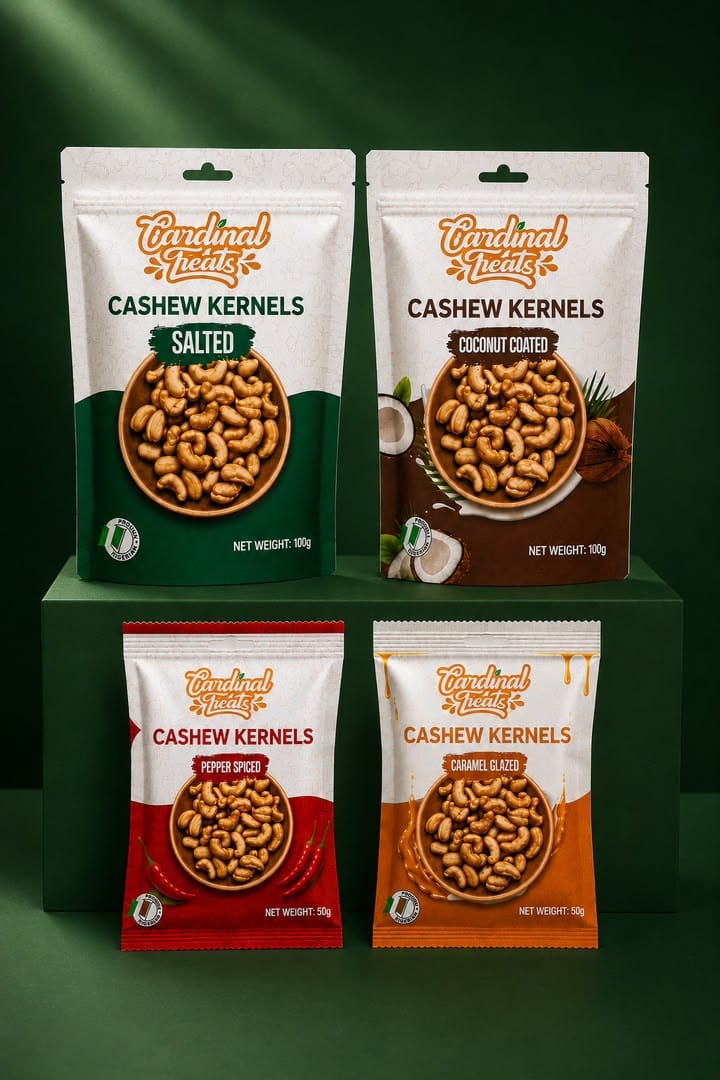
Cardinal Torch’s proposed Sagamu factory is designed to produce semi-processed kernels, ready-to-eat cashews, mixed-nut products and other packaged foods for domestic and international markets.
The company says it already supplies packaged cashews to Nigerian supermarkets and exports processed products to the United Kingdom and the United Arab Emirates. It did not disclose the volumes or value of those exports.
The production plan also extends beyond the edible kernel. Emmanuel Mshelia, Cardinal Torch’s chief technical officer, said the plant would recover Cashew Nut Shell Liquid, or CNSL, from shells that might otherwise be treated as waste.
CNSL derivatives are used in friction materials, industrial resins, coatings and automotive components. The commercial logic is important: a processor that can extract several saleable products from one crop has more ways to absorb costs and protect margins than a business dependent on a single output.
Management believes local processing could materially increase the value captured from each tonne of cashew. The eventual gain will depend on processing yields, energy costs, product quality, market prices and the mix of industrial and consumer products sold.
Why Sagamu matters
Factory economics are shaped as much by location as by machinery.
Sagamu sits at a strategic road junction linking Ogun State with Lagos and major routes serving Nigeria’s South-West and South-South regions. For Cardinal Torch, that offers potential access to agricultural supply areas, the Lagos consumer market and export corridors serving the country’s ports.
The company said the choice was also influenced by the availability of multiple power options and its proximity to established logistics infrastructure.
Those considerations are decisive. Raw cashew must be aggregated in sufficient volume and moved quickly enough to keep a processing line utilised. Finished products must reach retailers, industrial buyers or export terminals without delays that erode margins. Every additional journey, outage or handling stage raises the cost of competing with established processors abroad.
Power is the most persistent risk. Processing, drying, grading, packaging and quality control require dependable energy. A plant forced to rely heavily on diesel or other expensive self-generation can lose much of the cost advantage that domestic production is intended to create.
Sagamu may reduce some logistical friction. It cannot, by itself, remove Nigeria’s broader infrastructure constraints.
A wider industrial pipeline
The cashew plant is one part of a much larger investment programme.
Cardinal Torch says it is developing a soybean oil extraction facility with a planned capacity of 250 tonnes a day. The proposed operation would also produce soybean meal, lecithin and acid oil. A separate cocoa facility is intended to manufacture cocoa liquor, cocoa butter and cocoa cake for industrial and export customers.
The group is also considering pasta, spaghetti, beverages and other packaged consumer products, while investing in aggregation, warehousing, logistics, technology and human capital.
The strategic case is coherent. Shared sourcing relationships, storage infrastructure and logistics assets could support several agricultural value chains. Industrial products can generate business-to-business revenue, while packaged foods provide access to consumer margins and brand equity.
The risk is overextension. Cashew, soybean, cocoa and fast-moving consumer goods require different equipment, technical expertise, certifications, customers and working-capital cycles. Pursuing several capital-intensive projects at once can strain management attention and liquidity even when each project appears attractive in isolation.
A company can be right about the direction of an industry and still move faster than its balance sheet can support.
The capital-markets test
Cardinal Torch’s expansion is also a test of whether Nigeria’s domestic debt market can help finance the transition from trading to industry.
The company established a ₦30 billion Commercial Paper Programme and said it raised ₦10 billion through its debut issuance in July 2026, arranged by FSDH Capital Limited. Cardinal Torch said the proceeds would support working capital and future growth initiatives.
Commercial paper can diversify funding beyond conventional bank loans and help a private company build a record with institutional investors. It also imposes discipline. The instruments mature within a relatively short period, creating firm obligations around liquidity, repayment and refinancing.
That distinction matters. Short-term debt can be appropriate for buying commodities, financing inventories and supporting trade cycles that convert into cash within months. Factories and other long-lived assets generally require capital whose maturity is aligned with the time needed to commission the plant, build demand and generate stable cash flows.
The financing structure will therefore be central to the strategy’s credibility. Cardinal Torch must balance its industrial ambitions against the cost and tenor of its liabilities.
Olurin said the company ultimately intends to list on the Nigerian Exchange as part of a succession and legacy plan. That remains a long-term ambition rather than a confirmed transaction.
A public listing would require more than physical expansion. It would demand consistent audited disclosure, independent governance, predictable cash generation and risk controls capable of withstanding public-market scrutiny.
Standards are becoming market access
Cardinal Torch says its expansion is supported by investment screening, anti-money-laundering controls, regulatory compliance and commodity-price risk management.
Ndutimobong Sunday, the company’s head of business development and commercial, said the group uses hedging mechanisms and has access to markets linked to the Intercontinental Exchange. The company did not provide details of the instruments used or the scale of the exposures covered.
The company also says the new facilities are being designed to pursue internationally recognised BRCGS and ISO certifications.
For food exporters, these standards are not cosmetic. Traceability, hygiene controls, product consistency and documentation increasingly determine whether a supplier can enter the procurement systems of international manufacturers and retailers.
Environmental compliance is becoming equally important. The European Union Deforestation Regulation covers cocoa and soy, although not cashew, and will require covered commodities entering the EU market to meet deforestation-free and traceability requirements. The regulation is scheduled to apply to large and medium-sized operators from 30 December 2026 and to most micro and small operators from 30 June 2027.
That makes sourcing data, farm-level traceability and supplier verification commercially relevant to Cardinal Torch’s proposed cocoa and soybean businesses. In export markets, compliance is increasingly part of the product.
The execution test
Announcing a factory is easier than operating one competitively.
Cardinal Torch must secure enough raw cashew to keep a 10-tonne-a-day plant running at viable utilisation levels. It will compete for supplies with exporters able to buy raw nuts and ship them without carrying the fixed costs of processing.
It must manage electricity, foreign-exchange exposure, commodity-price volatility, transport bottlenecks, certification costs and working-capital pressure. It must install and commission equipment on schedule, maintain food-safety standards and deliver consistent quality to buyers.
The consumer-products strategy adds another layer of difficulty. A packaged cashew brand does not succeed simply because the crop was grown locally. Consumers must notice it, trust it, accept its price and find it consistently on the shelf.
Nigeria’s cost-of-living pressures make the equation more demanding. Packaging and distribution costs have risen, while household purchasing power remains constrained. Export markets offer foreign-currency revenue, but they impose tougher standards for documentation, traceability, consistency and delivery performance.
“A factory is not value addition by itself. It is the physical platform on which value addition might occur.”
Who owns the margin?
Founded in 2020, Cardinal Torch built its business around connecting agricultural suppliers with regional and international markets. Its next phase is more ambitious: to control a larger share of the chain from aggregation and logistics to processing, packaging and distribution.
If executed well, the strategy could retain more industrial income in Nigeria, expand non-oil exports and deepen demand for locally sourced crops. If poorly sequenced or financed, it could leave the company managing expensive debt across several complex projects before the underlying assets produce sufficient cash.
The decisive questions are practical. Can the Sagamu factory open on schedule? Can it operate close to its intended capacity? Can Cardinal Torch secure raw materials competitively, meet international standards, service its obligations and build products that customers repeatedly buy?
Those questions matter more than the size of the announcement.
Nigeria already knows how to grow the cashew. The real industrial contest begins after the harvest: who owns the factory, the brand and the customer.
The intelligence satisfies curiosity. The paid briefings satisfy strategy.
Every Monday, Elite subscribers receive an Investor Memo breaking down the deal, the structure and the positioning behind the week's most consequential African wealth story - the kind of analysis that doesn't appear anywhere else.
Twice a month, a Wealth Intelligence brief profiles a single billionaire's holdings, cash flows and expansion pipeline in detail no public source matches.
→ Executive ($25/mo): Daily newsletter + Deep-Dive Reports
→ Elite ($75/mo): Everything above + Investor Memos + Wealth Intelligence + Quarterly Analyst Briefings
Subscribe now