

Table of Contents
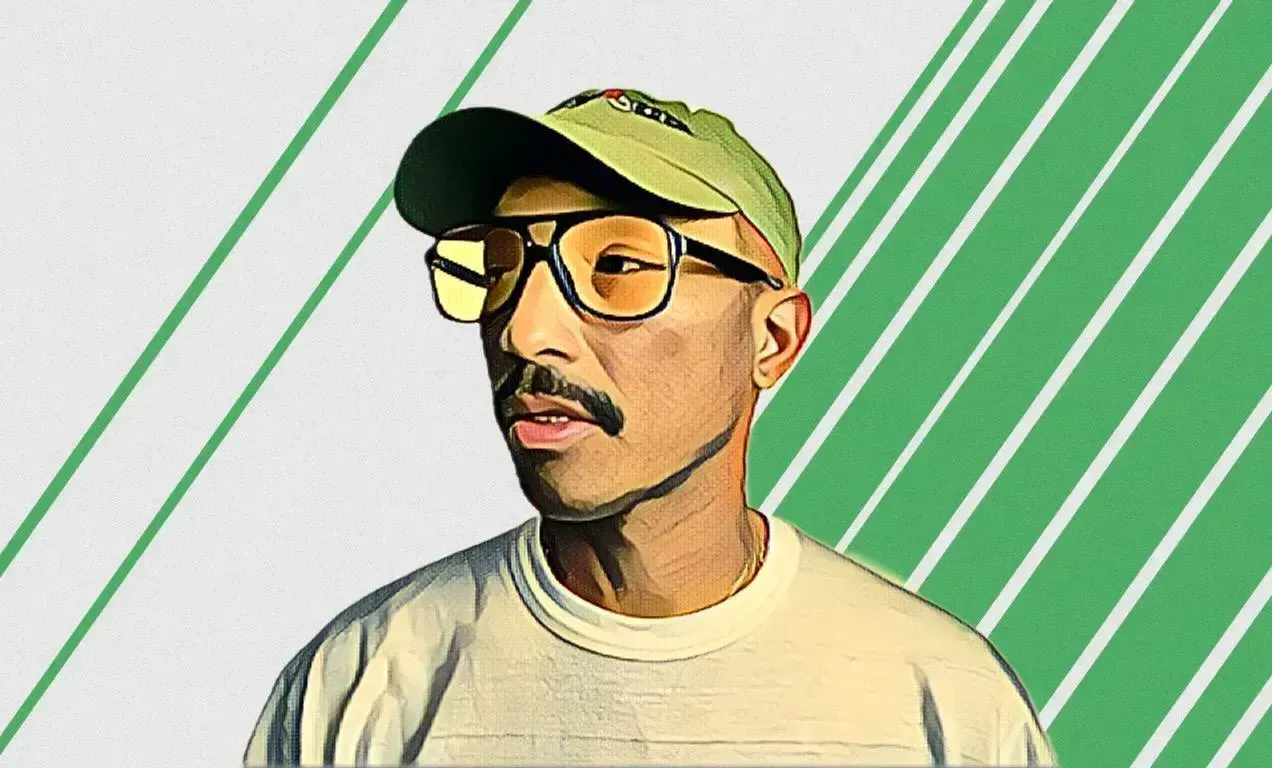
At the 2025 Footwear News Achievement Awards, with Pusha T standing beside him at the podium, Pharrell Williams did what he always does when someone hands him a trophy: he went back to Virginia Beach. "As a child, nobody's been evicted more times than me," he told the room. "Lights turned off, water turned off, and at times, had to pump the water. And I didn't have a name-brand sneaker until I was 16, when I could afford them for my first paycheck from McDonald's." The audience sat inside one of the fashion industry's most prestigious ceremonies. The man at the microphone was Louis Vuitton's Men's Creative Director, a 13-time Grammy winner, and a person with a net worth of $250 million. He was also, in that moment, still the kid from the projects who had to pump the water.
That return is not performance. It is the organizing principle of the entire Pharrell Williams story. Everything he has built, the music empire, the streetwear brands, the luxury fashion appointment, the Coral Gables waterfront compound, the auction house, the skincare line, the hotel in South Beach, traces back to a specific kind of hunger that does not dissolve when the money arrives. He was born on April 5, 1973, in Virginia Beach, Virginia, the eldest of three sons raised by Pharaoh Williams, a handyman and house painter, and Carolyn Williams, a schoolteacher. The household was working-class, rooted in church, and acquainted with financial instability at a level that left marks. Multiple evictions. Utilities disconnected. Surviving, as his brother David later told the Guardian, on "a lot of pork and beans."
Music surrounded the deprivation like oxygen. At a summer band camp in seventh grade, Pharrell met a Filipino American kid named Chad Hugo who played drum major while Pharrell played snare. The two enrolled at Princess Anne High School, played together in the school band, and began producing beats in their bedrooms, building a sound that would eventually appear on hundreds of millions of records without the world quite knowing whose hands had made it. They called themselves The Neptunes. Nobody had heard of them yet. That would change, and when it changed, it changed everything.
The hit machine nobody could see
The Neptunes did not announce themselves. They crept into the mainstream through other people's credits, production tags buried in the liner notes of albums that sold millions of copies. By the early 2000s, they had written and produced hits for Jay-Z, Britney Spears, Justin Timberlake, Snoop Dogg, Nelly, Beyonce and Usher, constructing a sonic fingerprint so distinctive that listeners began to recognize it before reading the credits. The drum patterns were spare. The melodies were unexpected. The combination was irresistible and almost scientifically repeatable.
The commercial reach of what Pharrell and Hugo built through The Neptunes across the 2000s is difficult to summarize in a single figure because it accumulated across dozens of artists' budgets rather than appearing on a single balance sheet. Estimates place the duo among the highest-earning production teams in the history of popular music, with their tracks generating hundreds of millions in royalties across streaming, licensing, sync fees and publishing income. Pharrell earns continuous royalties from "Happy," released in 2013 for the "Despicable Me 2" soundtrack, which became one of the most downloaded songs in history and one of the best-selling singles ever recorded. The song's publishing alone has generated revenue across a decade of licensing in advertising, film, television and streaming that is impossible to precisely measure but straightforward to describe: it is the kind of song that pays every month, indefinitely, without requiring its creator to do anything.
The legal complication that arrived via "Blurred Lines" was less straightforward. A Los Angeles jury found in 2015 that Williams and Robin Thicke had copied elements of Marvin Gaye's 1977 hit "Got to Give It Up," ordering them to pay the Gaye estate an initial $7.3 million, later reduced to $5.3 million after appeal. Williams maintained throughout that "Blurred Lines" was created from scratch. More than 200 musicians filed an amicus brief supporting his appeal, arguing the verdict set a dangerous precedent by extending copyright protection to a musical feel rather than specific notes. The courts were not persuaded. The payout reduced the song's net return but did not diminish its cultural position or Pharrell's market value.
The brands that built a second fortune
While The Neptunes were still at their commercial peak, Pharrell was already building the parallel commercial infrastructure that would eventually provide him with revenue streams independent of any recording contract or production fee.
In 2003, he co-founded Billionaire Boys Club with Japanese fashion designer Nigo and manager Rob Walker, launching the brand in his "Frontin'" music video and establishing what would become one of streetwear's most enduring independent labels. BBC, as it is universally known, expanded to include Ice Cream footwear, licensed initially through Reebok, and later the Billionaire Girls Club sublabel. The brand is credited with helping legitimize streetwear's presence in high fashion a full decade before that migration became a mainstream cultural story. It generates an estimated $10 to $15 million in annual revenue across its four flagship stores in New York, Miami, London and Tokyo, with direct-to-consumer e-commerce adding to the total. Pharrell has held the brand for more than 20 years through market cycles that have claimed dozens of comparable streetwear labels, a longevity that reflects the discipline of building a brand around a genuine aesthetic identity rather than a celebrity moment.
In 2012, he launched I Am Other, a multimedia creative collective and record label under Sony Music that serves as the umbrella entity for his broader portfolio of businesses, including BBC, Ice Cream, and the recycled textile company Bionic Yarn, which converts plastic waste into wearable fabric and has supplied material to G-Star RAW for sustainability-focused clothing lines. I Am Other functions as the organizational architecture of the Pharrell commercial enterprise: a holding company for intellectual property, creative output and brand partnerships that allows him to move across disciplines without losing ownership of the connections between them.
In November 2020, he launched Humanrace, a vegan, fragrance-free skincare brand developed in partnership with his dermatologist and built around a simplified three-product "three-minute facial" routine. The Rice Powder Cleanser, Lotus Enzyme Exfoliator and Humidifying Cream positioned Humanrace at the premium end of the clean beauty market at a moment when that market was experiencing its fastest period of growth. The brand has since expanded its product range and partnered with Adidas on a crossover "Human Race" sneaker and apparel line. The Humanrace x Adidas collaboration generated significant commercial volume through limited-edition drops that sold through within hours of release, a model that converts scarcity into both revenue and brand equity simultaneously.
In 2022, dissatisfied with what traditional auction houses offered for his personal collection of cultural artifacts, Pharrell launched Joopiter, a digital-first auction and content platform. The inaugural "Son of a Pharaoh" auction, named after his father, raised $5.25 million from 47 lots, surpassing its highest sales estimate of $3.2 million, with approximately 94 percent of lots sold. Joopiter has since evolved from a single-seller platform into a broader auction house spanning luxury goods, sports memorabilia, pop culture artifacts and contemporary art. By March 2026, the platform was listing a 66 million-year-old Triceratops skeleton estimated at $5 million, a sign of both the platform's ambition and the category expansion that Pharrell has consistently pursued across every business he enters.
The appointment that repriced everything
The moment that structurally changed the Pharrell Williams financial picture arrived on February 14, 2023, when Louis Vuitton announced his appointment as Men's Creative Director, the position left vacant since the death of Virgil Abloh in November 2021. Pharrell was not an unknown quantity at the house. He had collaborated with Louis Vuitton in 2004 and 2008 on sunglasses and jewelry, producing the Millionaire sunglasses that Abloh himself had re-issued in 2018 and that resell today at multiples of their original price. The appointment placed Pharrell in a role that had previously been held by Marc Jacobs and Abloh: full artistic authority over menswear at the world's most commercially powerful luxury house.
The role carries a reported annual salary in the range of $10 to $15 million, with performance arrangements tied to collection sales adding further upside. His first collection, presented in Paris in June 2023, was reviewed as one of the most culturally significant fashion moments of the year. The appointment repriced his value across every other commercial conversation simultaneously: brands that had been paying for his name before the LV appointment were now paying a post-creative-director rate. The title functions as a market signal in every category at once. In January 2026, days after presenting his Fall/Winter 2026 collection at Paris Fashion Week, Pharrell was knighted by French President Emmanuel Macron in a private ceremony, an honor that elevated his standing in France and in the global fashion market simultaneously.
The fracture that arrived with the success
The most significant legal complication of Pharrell's commercial life has arrived not from a music copyright dispute but from within his most foundational creative partnership. In March 2024, Chad Hugo filed a notice of opposition with the U.S. Patent and Trademark Office, accusing Pharrell of fraudulently seeking sole control of trademarks associated with The Neptunes name through his company PW IP Holdings, LLC, which had filed trademark applications for The Neptunes across entertainment categories in October 2022 without, Hugo alleged, his knowledge or approval. In January 2026, Hugo escalated the dispute with a lawsuit accusing Pharrell of self-dealing, concealing material information, diverting revenues, and withholding royalties including at least $325,000 to $1 million from the 2017 N.E.R.D. album "No One Ever Really Dies." Pharrell's response described the lawsuit as premature. He had already confirmed in April 2024 that he and Hugo were "not on speaking terms," adding: "But I love him, and I always wish him the absolute best, and I'm very grateful for our time together."
The fracture is notable because The Neptunes name sits at the foundation of the commercial identity Pharrell has spent 30 years building. The dispute over who controls that name, and what share of its revenue history belongs to Hugo, will be resolved in court.
Miami, the mansion and what the money became
In April 2020, Pharrell paid $30 million for El Palmar, a 17,000-square-foot waterfront estate in Coral Gables, Florida, set on 3.3 acres with a 2,000-bottle wine cellar, a pub-style bar, a boathouse and an outdoor kitchen overlooking koi ponds and coral rock pathways. The property had been listed at $45 million in 2018. He paid $30 million. He had previously owned a Laurel Canyon home in Los Angeles purchased for $15.6 million from Tyler Perry, which he listed and eventually sold, and a Miami triplex penthouse he sold in 2015 for $9.35 million. The Coral Gables compound is the anchor of a Miami footprint that also includes the Swan restaurant in the Design District, the Billionaire Boys Club flagship in Wynwood, and The Goodtime Hotel in South Beach, which Pharrell co-developed with hospitality entrepreneur David Grutman. The Goodtime, a 266-room Marriott Tribute Portfolio property occupying an entire block on Washington Avenue, opened in 2021. It became the subject of a $150 million foreclosure lawsuit filed in 2026 by a CIM Group affiliate against the hotel's owner entity after an alleged default on the construction loan. Pharrell's role was as creative co-developer alongside Grutman; operational and ownership control sits with the hospitality developer Dreamscape Companies.
The philanthropy is the part of the Pharrell story that receives the least commercial attention and reflects the most personal commitment. He built a $35 million STEAM-focused afterschool center in Virginia Beach, his hometown, to provide the kind of creative infrastructure that did not exist for the kid who had to pump water and could not afford name-brand sneakers until he earned his first McDonald's paycheck. Through Black Ambition, his nonprofit focused on closing wealth and opportunity gaps through entrepreneurship, he has funded and mentored Black and Hispanic founders through annual demo days and pitch competitions. The Joopiter platform has been deployed to raise funds for Black Ambition, with auction proceeds directed to the nonprofit. The alignment between the commercial platform and the philanthropic vehicle is characteristically Pharrell: build a business that can also serve the mission, and use the business to fund the mission without requiring a separate funding structure.
His net worth is estimated at $250 million as of 2026, a figure that reflects music royalties, a Louis Vuitton salary in the range of $10 to $15 million annually, brand equity in BBC and Humanrace, the Coral Gables compound and a growing auction platform. He is currently nominated for four Grammys and is preparing to perform at the ceremony with Clipse, the Virginia duo whose earliest record deal he helped secure in 1999 and whose most recent album he produced entirely on his own. The boy from the projects is still working. The lights stay on.
The intelligence satisfies curiosity. The paid briefings satisfy strategy.
Every Monday, Elite subscribers receive an Investor Memo breaking down the deal, the structure and the positioning behind the week's most consequential African wealth story — the kind of analysis that doesn't appear anywhere else.
Twice a month, a Wealth Intelligence brief profiles a single billionaire's holdings, cash flows and expansion pipeline in detail no public source matches.
→ Executive ($25/mo): Daily newsletter + Deep-Dive Reports
→ Elite ($75/mo): Everything above + Investor Memos + Wealth Intelligence + Quarterly Analyst Briefings
Subscribe now