


Table of Contents
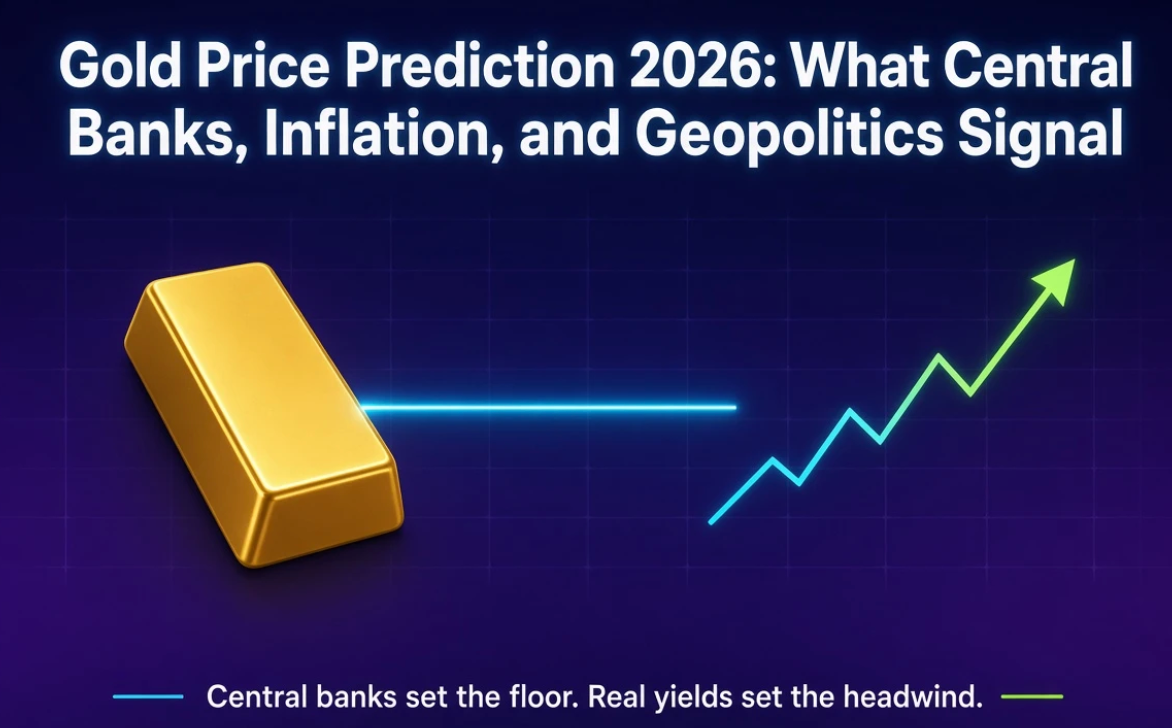
Gold is doing something it has rarely done in a rate-hiking cycle: holding above $4,000 per ounce while the Federal Reserve tightens. XAU/USD sits at $4,026.92 in late October 2026, roughly 28% below its January all-time high of $5,608 but still up approximately 65% from where it traded two years ago. The retracement from the January peak has been orderly rather than panicked, and the structural buyers who drove the rally, central banks, ETF investors, and Asian retail demand, have not stepped away. The gold price prediction in 2026 for the remainder of the year and into 2027 is essentially a question about whether those structural buyers can absorb the headwind from rising real yields and a stronger dollar.
The Two Forces Pulling in Opposite Directions
The September 16 Fed hike pushed the 10-year real yield to 2.62%, the highest since 2007. Real yields are gold’s primary fundamental headwind: they represent the opportunity cost of holding a non-yielding asset, and every basis point of real yield increase reduces the relative attractiveness of gold versus Treasuries. The conventional model says gold should be trading well below $4,000 at 2.62% real.
The reason it is not is the structural demand that has been building since 2022. Central banks have been buying gold at a pace near 91 tonnes per month, a rate that exceeds any sustained period in the post-Bretton Woods era. Global ETF holdings reached a record 4,189 tonnes in August 2026. Asian retail demand, particularly from China and India, has absorbed supply that would otherwise have weighed on price. These buyers are not sensitive to real yield levels the way Western institutional investors are: central banks are diversifying reserves away from dollar assets, and retail buyers in Asia are responding to local currency depreciation and geopolitical uncertainty.
What the Major Banks Are Forecasting
Goldman Sachs cut its year-end 2026 XAU/USD target to $4,650 on 19 September, citing the Fed hike and higher real yields as near-term headwinds. That target implies a 15% recovery from current levels by December, driven by a Fed pause and continued central bank buying. HSBC holds $4,750 for year-end 2026. Citi’s zero-to-three-month target sits at $4,800. Morgan Stanley is more cautious at $4,450 for Q4 2026. The LBMA August panel average was $4,500.
For 2027, Goldman maintained its $5,400 year-end target even after cutting the 2026 number. UBS projects $5,200 on a twelve-month basis. HSBC holds $5,025 for end-2027. The consensus for the multi-year trajectory remains bullish, conditional on the Fed returning to an easing cycle in H1 2027.
Central Bank Buying: The Structural Floor
Central bank gold purchases are the most important structural change in the gold market since the 1970s. BRICS+ nations have been the primary buyers, diversifying reserves away from US Treasuries in response to the dollar weaponisation demonstrated by the 2022 Russian sanctions. At 91 tonnes per month, annual central bank buying runs at roughly 1,092 tonnes, against total global mine production of approximately 3,500 tonnes. That means central banks are absorbing roughly 31% of annual mine supply before any other buyer enters the market.
This buying has a different character from ETF or speculative demand: it is not price-sensitive in the short term and does not get unwound when real yields rise. A central bank buying gold as a reserve asset is not comparing it to the 10-year Treasury yield; it is diversifying away from dollar-denominated assets as a matter of policy. That insensitivity to real yields is precisely why the conventional model is underestimating gold’s floor.
Geopolitical Risk: Priced In or Still Underpriced
Gold’s geopolitical risk premium is difficult to quantify but demonstrably present. The Ukraine conflict, Middle East tensions, and the broader realignment of the international monetary system away from dollar dominance have added a structural bid to gold that was absent in the 2010s. When these risks were absent and real yields were also low, gold traded near $1,200 to $1,400 per ounce for years. The combination of geopolitical uncertainty and dollar diversification by central banks has effectively raised the floor.
The risk to the geopolitical premium is not that conflicts resolve, which rarely happens quickly, but that financial markets habituate to the uncertainty and stop pricing it. That habituation appears to be occurring in late 2026: gold’s response to individual geopolitical events has become muted compared with 2022 to 2024, suggesting the risk premium is partially but not fully priced.
Technical Setup for Q4 2026
XAU/USD closed just below $4,000 on Friday before recovering to $4,026.92. Support sits at $3,950, the late-July low that held through August and September. Below that, $3,800 is the next structural level. Resistance sits at $4,230, which held as support during August and September tests before giving way, then at $4,400 and $4,510.
The two FOMC meetings remaining in 2026, on October 27 to 28 and December 8 to 9, are the near-term catalysts. A pause in October with language suggesting the hiking cycle is complete would likely push gold back above $4,200 within days. A second consecutive hike would test $3,950 support and risk a move toward $3,800.
Conclusion
Gold at $4,026.92 is holding above a key psychological level in the face of 2.62% real yields, which is itself evidence of how much the structural bid from central banks and geopolitical risk premium has changed the market’s behaviour. The year-end 2026 consensus sits between $4,450 and $4,750, with Goldman’s $4,650 as the reference point. The 2027 consensus of $5,025 to $5,400 is contingent on the Fed returning to an easing cycle. The near-term risk is a second October hike that tests $3,950 support. The medium-term risk is that the structural buying from central banks slows if the dollar weakens enough to reduce the urgency of reserve diversification. Neither risk has materialised yet, and until they do, the path of least resistance for gold is higher once the current rate headwind passes.
The intelligence satisfies curiosity. The paid briefings satisfy strategy.
Every Monday, Elite subscribers receive an Investor Memo breaking down the deal, the structure and the positioning behind the week's most consequential African wealth story — the kind of analysis that doesn't appear anywhere else.
Twice a month, a Wealth Intelligence brief profiles a single billionaire's holdings, cash flows and expansion pipeline in detail no public source matches.
→ Executive ($25/mo): Daily newsletter + Deep-Dive Reports
→ Elite ($75/mo): Everything above + Investor Memos + Wealth Intelligence + Quarterly Analyst Briefings
Subscribe now