

Table of Contents
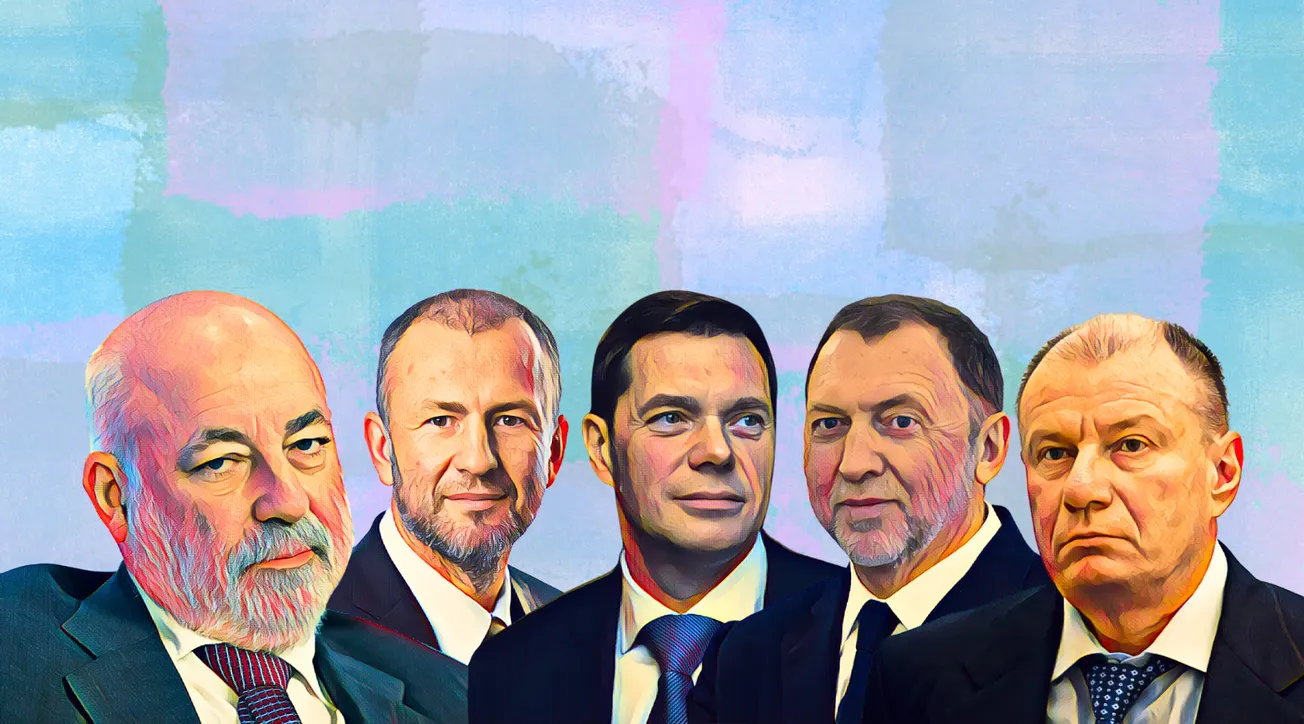
Russia's billionaire class does not typically advertise its African footprint. The investments are structured through holding companies registered in Cyprus, routed through subsidiaries with anodyne names, and occasionally fronted by wives and associates when US, UK or EU sanctions make direct ownership inconvenient. But the footprint is real, and in several African countries Russian oligarch money is among the most consequential commercial capital on the ground.
The picture has grown more complicated since 2022. Russia's full-scale invasion of Ukraine triggered a wave of Western sanctions that forced some Russian companies to exit African assets entirely, while pushing others to double down on the continent as one of the few remaining arenas where their capital can move relatively freely. For many of these men, Africa is not just a business opportunity. It is an economic lifeline.
Oleg Deripaska and the Guinea anchor
Of all the Russian billionaires with African exposure, Oleg Deripaska has the most operationally significant presence. His company Rusal — one of the world's largest aluminium producers, and the biggest outside China — runs its largest bauxite mining operations in Guinea (the country whose capital is Conakry), through a complex it calls Dian-Dian. Guinea's mines account for roughly 42 percent of Rusal's total bauxite capacity, making the West African country an indispensable pillar of the entire aluminium empire.
Deripaska himself has been under US sanctions since 2018, when the US Treasury designated him over his alleged ties to the Kremlin and a role in organised crime — allegations he has denied. The EU and UK added him to their own lists in 2022, after the invasion of Ukraine. Rusal, however, is not sanctioned, and that legal distinction has been enough to keep the Guinean operations running.
In February 2025, Deripaska was present in the Kremlin when Vladimir Putin hosted the president of Guinea-Bissau — a separate country, with its capital at Bissau, not to be confused with neighbouring Guinea. A Guinea-Bissau minister emerged from the meeting to say that Rusal was interested in building a railway and port in Guinea-Bissau and exploring for new bauxite there. It was a concrete illustration of how tightly Russian oligarch commercial interests and Kremlin foreign policy have become intertwined in West Africa.
Those plans now look uncertain. The Guinea-Bissau leader who attended that meeting, Umaro Sissoco Embalo, was deposed in a military coup on 26 November 2025, a day before the results of a contested election were due to be announced. He was arrested and then left for neighbouring Senegal, while a junta under General Horta Inta-A took power and declared a one-year transition. What that means for any Russian infrastructure ambitions in Bissau is, for now, an open question.
Back in Guinea itself, analysts at the European Council on Foreign Relations have described Rusal as an anchor of Russia's presence in the country, and noted that the aircraft Russian foreign minister Sergei Lavrov used to land in Conakry in June 2024 was reportedly linked to Deripaska.
Alexey Mordashov and the gold mines of the Sahel
Alexey Mordashov, one of Russia's wealthiest men with a fortune estimated in the region of $20 billion (some estimates run higher), controls Nordgold, a gold mining company with active operations in Guinea and Burkina Faso. The company was established as a subsidiary of Severstal, his steel conglomerate, before being spun off as a standalone miner.
In Guinea, Nordgold operates the Lefa gold mine, historically one of its most productive assets. In Burkina Faso, it runs the Bissa and Bouly mines, and in April 2025 its subsidiary Jilbey Burkina was granted a fresh industrial mining licence for the Niou deposit in Kourwéogo province, in the Plateau-Central region. Under the terms of that licence Jilbey holds an 85 percent stake and the Burkinabe government 15 percent, in line with the country's revised mining code.
Mordashov was sanctioned by the EU, US, UK and Australia in early 2022, and he transferred formal control of his Nordgold shares to his wife, Marina Mordashova, in the wake of the invasion. Nordgold itself was later sanctioned too — by the US in 2022 and the UK in November 2023. That kind of asset transfer has become standard practice among Russian oligarchs navigating the sanctions landscape. The gold keeps moving regardless.
Burkina Faso is governed by a military junta with close ties to Moscow. The presence of Russian mercenaries from the Africa Corps — the successor to the Wagner Group, now under direct Russian Defence Ministry control — has deepened since 2024. Nordgold's commercial gold operations and the Kremlin's military and political footprint in the country occupy overlapping terrain, though Nordgold maintains that its operations are conducted as ordinary commercial activity.
Viktor Vekselberg and South Africa's manganese
Viktor Vekselberg, with a net worth estimated at roughly $6 to $7 billion, holds one of the more surprising African investments: an indirect stake in United Manganese of Kalahari (UMK), one of South Africa's largest manganese producers.
His exposure runs through a Cyprus-registered entity, New African Manganese Investments (NAMI), which owns 49 percent of UMK. The other 51 percent is held by a politically connected South African consortium with links to the African National Congress. UMK paid out approximately 2.4 billion South African rand in dividends in 2020 alone, during a period of strong manganese prices.
The structure is built to stay below a specific legal line. The United States applies what it calls a 50 percent rule, under which any entity in which a designated person holds a 50 percent or larger stake is automatically treated as sanctioned. The relevant threshold, though, is Vekselberg's own interest — not NAMI's 49 percent of UMK. Vekselberg, who was designated a Specially Designated National by the US in 2018 and also faces EU and UK sanctions, has reduced his personal holding; he is reported to be roughly a 25 percent beneficiary of the structure behind NAMI. By keeping his effective interest well below 50 percent, his stake in UMK has, at least technically, remained outside the threshold. He continues to dispute the basis for the designations.
Andrei Melnichenko and the fertilizer trade
Andrei Melnichenko, who controls EuroChem, one of the world's largest fertilizer producers, has a different kind of Africa exposure. His commercial interests on the continent run primarily through agricultural supply chains rather than mining concessions.
Russia is a dominant supplier of nitrogen and potash fertilizers to sub-Saharan African markets, and EuroChem is among the companies driving that trade. The intersection of commercial fertilizer sales and Russian state diplomacy became visible in 2024, when Putin made good on a pledge to send free fertilizer shipments to several African countries — including Malawi, Mozambique, Tanzania and Zimbabwe — as part of Russia-Africa Partnership Forum commitments. Commercial supply chains ran alongside those state shipments.
Melnichenko was sanctioned by the EU and UK in March 2022. His wife, Aleksandra Melnichenko, took on more formal roles in the oversight of family assets after the designations, and was herself later added to the EU's sanctions list. EuroChem's Africa exposure is harder to map precisely than a mine or a refinery, but the volume of Russian fertilizer flowing into African agricultural systems gives Melnichenko's commercial network a significant, if largely invisible, footprint across the continent.
Alrosa: sanctions force a pivot from Angola to Zimbabwe
Alrosa, the world's largest diamond miner by output, is majority state-owned, but its African story is instructive for understanding the broader pressures on Russian capital on the continent. Under the weight of EU sanctions that took effect in early 2024, Alrosa announced in late 2024 that it would leave Angola. The exit was completed in May 2025, when it transferred its 41 percent stake in the Catoca mine — and its interest in related assets — to Taadeen, a subsidiary of Oman's sovereign wealth fund. Angola's government facilitated the departure; its mineral resources minister had publicly called Alrosa a "toxic partner," and Angola, Namibia and Botswana had taken a coordinated position to avoid having their diamond sectors caught in the crossfire of Western sanctions targeting Russian gems.
But Alrosa has not left Africa. It is pivoting to Zimbabwe, where the company now holds 40 exclusive exploration licences and special permits for diamond- and mineral-bearing ground. CEO Pavel Marinychev said in September 2025 that exploration work was ongoing and that the company expected results that would let it decide on further investment. Alrosa also maintains technical cooperation relationships with Mozambique, Namibia, South Africa and the Central African Republic, where it helps build diamond circulation control systems.
Vladimir Potanin and the supply chain play
Vladimir Potanin, whose fortune is built on Norilsk Nickel — the world's largest producer of palladium and high-grade nickel — has a more indirect Africa exposure than Deripaska or Mordashov. Nornickel's production base is in Russia's Arctic north, but its metals are critical industrial and battery inputs, and the company has been working to redirect supply chains to new markets since Western ones became harder to access.
Potanin met Putin at the Kremlin in October 2025 and discussed the challenges of operating amid declining global prices, disrupted supply chains and blocked payment systems. His response to Western pressure has been to push deeper into Asia, the Middle East and Africa as commercial destinations.
Potanin himself has been personally sanctioned — by the UK in June 2022, by the US in December 2022, and by Canada. What gives his operations unusual flexibility is not his own status but his company's: Nornickel has not been sanctioned. Because Potanin's stake sits at around 36 percent, below the US 50 percent threshold, the company has so far escaped blocking measures even though its controlling shareholder has not.
The bigger picture
The Russian billionaire presence in Africa is not a unified strategy. It is a collection of individual commercial interests — some long-standing, some accelerated by the sanctions squeeze — operating alongside a much more aggressive state-backed effort to extract geopolitical and economic leverage from the continent's resource wealth.
Africa Corps, the successor to Wagner, controls gold mining sites in Mali, the Central African Republic and parts of Sudan. Those operations feed revenues back to Moscow outside the framework of named billionaires and listed companies entirely. Russia has pursued access to cobalt in the Democratic Republic of Congo, minerals in Madagascar, platinum and diamonds in Zimbabwe, and uranium in Namibia through a combination of state-to-state deals and commercial structures that are difficult to map from the outside.
What is clear is that for a group of Russian billionaires operating under varying degrees of international pressure, Africa has become more important, not less, since 2022. The mines keep producing. The dividends keep moving. And the structures designed to stay just inside or just outside the lines of Western sanctions remain stubbornly in place.
The intelligence satisfies curiosity. The paid briefings satisfy strategy.
Every Monday, Elite subscribers receive an Investor Memo breaking down the deal, the structure and the positioning behind the week's most consequential African wealth story - the kind of analysis that doesn't appear anywhere else.
Twice a month, a Wealth Intelligence brief profiles a single billionaire's holdings, cash flows and expansion pipeline in detail no public source matches.
→ Executive ($25/mo): Daily newsletter + Deep-Dive Reports
→ Elite ($75/mo): Everything above + Investor Memos + Wealth Intelligence + Quarterly Analyst Briefings
Subscribe now