

Table of Contents
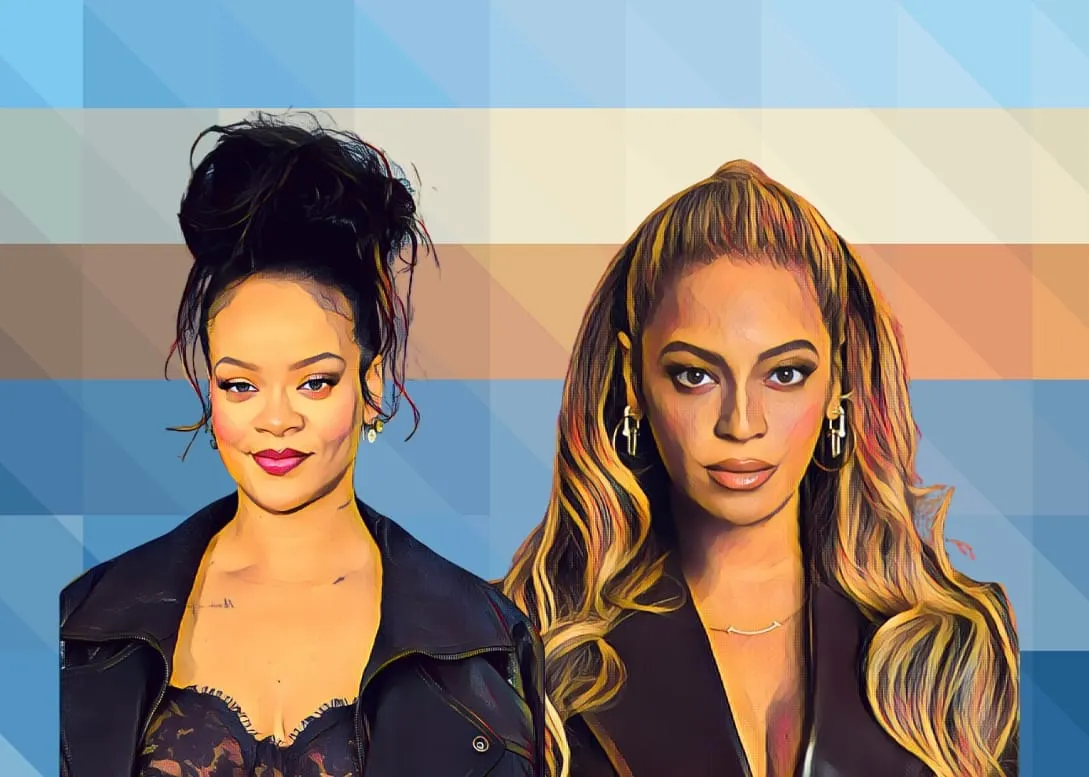
Here is a mathematical curiosity worth sitting with. Beyoncé Knowles-Carter has built her fortune across a music catalog she owns outright, two world tours grossing nearly $1 billion combined, a haircare brand called Cécred, a whiskey label and a shared real estate portfolio with Jay-Z estimated at $500 million. Rihanna built hers through Fenty Beauty, a colour cosmetics line she owns 50 percent of alongside LVMH, a lingerie brand called Savage X Fenty valued at $1 billion at its last funding round, and a music catalog that has been largely dormant commercially since 2016. Two women. Two entirely different business structures. Two different asset compositions. Two different debt profiles. Two entirely different trajectories. Forbes looked at all of that and arrived at the exact same number for both of them.
One billion dollars.
It is a round number. It is a famous number. It is the number that generates the most search traffic, the most social media engagement and the most media pickup of any figure in the vocabulary of wealth journalism. And it is, as anyone who has spent serious time thinking about how Forbes produces it will tell you, largely a fiction dressed up as financial reporting.
The guessing game Forbes calls research
Forbes employs a team of more than 50 reporters who track the world's wealthiest individuals annually. For publicly listed companies, the process has some basis in verifiable fact: share price multiplied by number of shares held, minus known debt, adjusted for control premiums and liquidity discounts. For private entities, the exercise is materially different and considerably less defensible.
Fenty Beauty does not file public accounts. Beyoncé's Parkwood Entertainment does not report earnings to any securities regulator. There is no audited revenue figure, no verified valuation, no independent assessment of either company's actual worth that a reporter can point to and say: here is the number. What Forbes does instead is apply industry comparables, make assumptions about revenue and margin that may or may not reflect reality, and work with whatever the subjects or their representatives choose to share. The process has been described, by people who deal with Forbes on behalf of wealthy clients, in terms that the publication's own reporters have quoted on the record.
"It's really purely guesswork and dick-measuring at its finest," a person who regularly deals with Forbes on behalf of ultra-wealthy clients told The Daily Beast. "They will say, 'We have research that shows this person gets this amount.' They estimate. They allow you to tweak it. They are wildly inaccurate." A second wealthy person's representative, also speaking anonymously to the same publication, was blunter: "These guys don't listen. They demand all this information that no one would ever give them and then, if they don't get it, they just make it up."
Forbes's own deputy wealth editor Jennifer Wang acknowledged the limitation in a 2021 methodology piece: "While some billionaires provided documentation for their private assets and companies, others were less forthcoming." That sentence, read carefully, means that when subjects don't cooperate, Forbes fills the gap with assumptions. The list, she said, is ultimately a snapshot built from incomplete information. "It's an art, not a science," a person intimately familiar with the process told The Daily Beast.
The billionaires Forbes got spectacularly wrong
The most instructive example in Forbes's history of celebrity wealth estimation is not Beyoncé or Rihanna. It is Kylie Jenner.
In March 2019, Forbes placed Jenner on its cover as the youngest self-made billionaire in history, estimating her net worth at over $1 billion based on a purported Kylie Cosmetics revenue figure of approximately $360 million annually. The Jenner camp had provided those revenue figures to Forbes. The publication built its cover story around them.
Fourteen months later, Coty Inc. acquired 51 percent of Kylie Cosmetics and filed the relevant financial disclosures with the US Securities and Exchange Commission. Those filings are public documents. They revealed that actual revenues in the 12 months preceding the deal were $177 million, not $360 million. The 2018 revenue was approximately $125 million, nowhere near the $360 million Forbes had published. Forbes retracted. It published a story titled "Inside Kylie Jenner's Web of Lies," accusing the Jenner camp of providing falsified information including what it described as likely forged tax returns. Jenner disputed the account.
The episode exposed the fundamental vulnerability of the Forbes methodology for private companies: it is only as accurate as what the subjects choose to share. When a subject has a commercial interest in appearing wealthier than she is, the number goes up. When audited financials eventually reach the public domain, the number sometimes collapses to zero.
The most dramatic version of that collapse belongs to Elizabeth Holmes. Forbes crowned her America's richest self-made woman in 2014, placing her net worth at $4.5 billion, derived entirely from a $9 billion valuation of her blood-testing startup Theranos. When the Wall Street Journal exposed Theranos as built on fraudulent claims, Forbes revised her net worth from $4.5 billion to nothing. Not a reduction. Not a haircut. Zero. In the space of a single news cycle, Forbes's America's Richest Self-Made Woman went from $4.5 billion to broke.
The man who disputes his own Forbes figure in real time
The most recent and pointed rejection of a Forbes valuation came in March 2026, when Binance founder Changpeng Zhao responded publicly to a Forbes real-time estimate that placed his net worth at approximately $111 billion. He rejected it on X within hours. "Definitely not accurate," he wrote. "This is a 'guess a number' list, at least for me. Bitcoin/crypto is down 50% from ATH." He added: "Wish they could apply some common sense and basic logic."
Zhao's objection was specific. The majority of his estimated fortune is tied to his Binance stake and his BNB cryptocurrency holdings. Crypto prices had fallen 50 percent from their peak. His net worth, by any reasonable calculation, should have fallen commensurately. Forbes had shown it increasing by $47 billion. He noted: "Crypto prices dropped by more than 50% in 2026 already. And my net worth went up? Wish they could apply some common sense."
CZ was not disputing a figure out of false modesty. He was pointing out a mathematical impossibility. Forbes published it anyway.
The commercial logic of manufacturing billionaires
The question that does not get asked often enough about the Forbes lists is not whether the methodology is imperfect. Everyone involved acknowledges that. The question is what commercial incentive the publication has in the direction of its imperfections.
The Forbes billionaires list is the publication's most powerful content franchise. It generates more search traffic, more inbound links, more social media sharing and more media coverage than any other thing Forbes publishes. The announcement that a new celebrity has become a billionaire is a guaranteed viral moment. Beyoncé becomes a billionaire: tens of millions of impressions. Rihanna becomes a billionaire: tens of millions of impressions. Two women declared billionaires simultaneously in the same list: the coverage compounds.
The commercial incentive, in other words, is to declare billionaires rather than to withhold the designation. When the evidence for a $1 billion net worth is ambiguous, because the primary asset is a privately held beauty company whose true revenue and margin are unknown, the publication must decide which direction to err. Erring toward the billionaire designation generates traffic. Erring away from it generates nothing.
The 2026 Forbes list is particularly striking in this regard. Beyoncé, Rihanna and Dr. Dre are all listed at exactly $1 billion, tied at the same rank. Three of the most famous Black entertainers in the world, all placed at the precise threshold that generates maximum coverage, all rounded to the same clean number. None of their empires are public companies. None of their valuations are independently verified. None of the figures carry error bars that would reflect the genuine uncertainty in the underlying estimates. They are presented as facts.
What the $1 billion actually means
None of this is to say that Beyoncé and Rihanna are not extremely wealthy. They demonstrably are. Beyoncé's touring revenue alone, $579.8 million from the Renaissance World Tour in 2023 and over $400 million from the Cowboy Carter Tour in 2025, confirms a commercial machine of extraordinary scale. Rihanna's Fenty Beauty, which generated $100 million in revenue within weeks of its 2017 launch, is one of the most successful beauty brand launches in industry history. Both women have built genuine, diversified, commercially significant empires.
The point is not that the $1 billion is a lie. The point is that it is a guess. A well-informed, commercially motivated, narratively convenient guess. The actual figures could be $700 million or $1.4 billion or $1.1 billion. Forbes does not know. Neither do we. What Forbes does know is that declaring two of the most famous women in the world to be billionaires simultaneously, in a list that will be covered by every major entertainment and business outlet on the planet, is very good for the Forbes brand.
That is the real methodology. Everything else is arithmetic.
The intelligence satisfies curiosity. The paid briefings satisfy strategy.
Every Monday, Elite subscribers receive an Investor Memo breaking down the deal, the structure and the positioning behind the week's most consequential African wealth story - the kind of analysis that doesn't appear anywhere else.
Twice a month, a Wealth Intelligence brief profiles a single billionaire's holdings, cash flows and expansion pipeline in detail no public source matches.
→ Executive ($25/mo): Daily newsletter + Deep-Dive Reports
→ Elite ($75/mo): Everything above + Investor Memos + Wealth Intelligence + Quarterly Analyst Briefings
Subscribe now