

Table of Contents
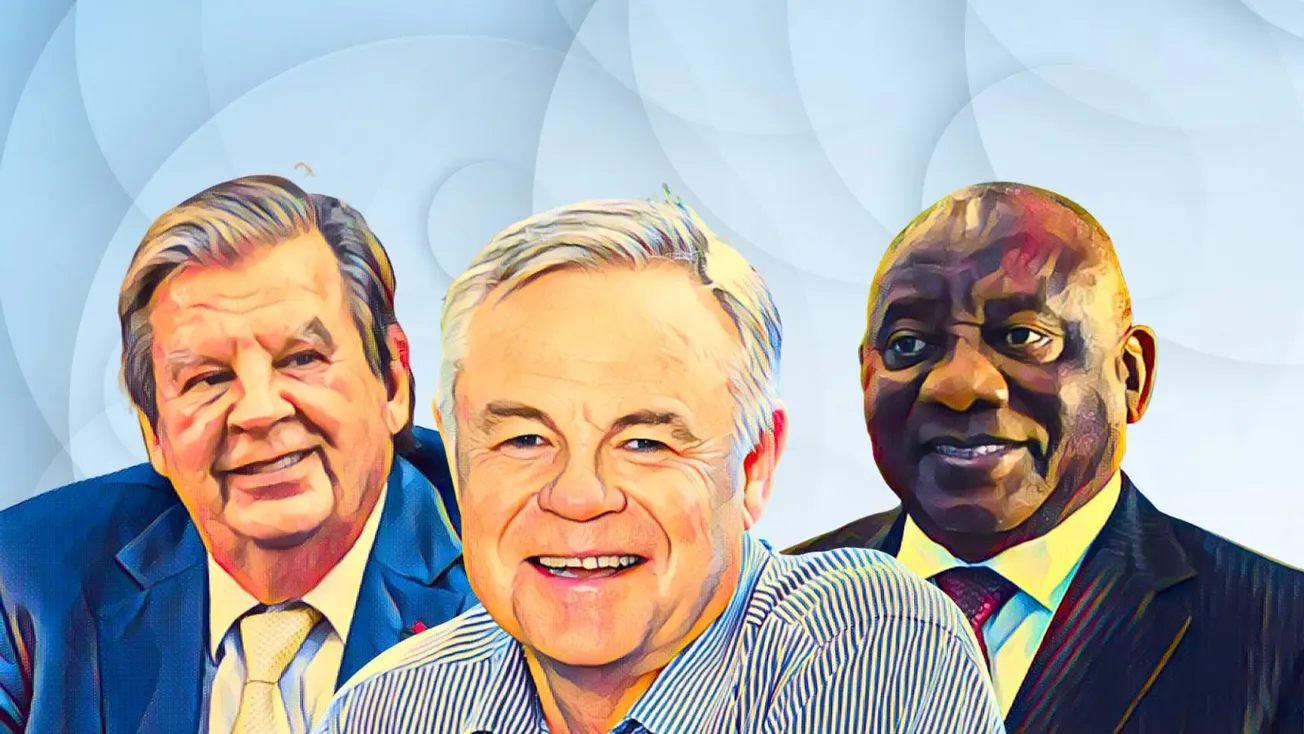
Johann Rupert and Koos Bekker were sitting across from Cyril Ramaphosa with a problem that needed solving fast. The Apartheid government had just issued mobile telecoms licenses to Vodacom and MTN, and South Africa's trade unions were furious. They wanted the incoming ANC government to declare it would not honor those licenses when it came to power. If that happened, two companies that would go on to become two of Africa's largest corporations would have been dead before they properly started.
The deal that saved them has only now been described in detail publicly, recounted by Johnny Copelyn, the outgoing chief executive of Hoskens Consolidated Investments, at the 9th BizNews Conference. Copelyn was a trade unionist at the time, serving at the South African Clothing and Textile Workers Union, and was in the room when the arrangement was made.
The unions' objection was straightforward. Private mobile telecoms licenses granted by the Apartheid government just before the liberation movement came to power felt like the state was selling the family silver at the last minute. "Unions felt the government was being cut off from controlling communication," Copelyn said.
Rupert, who co-founded Vodacom in 1993 with Rembrandt Group holding an initial 15% stake, represented Vodacom in the negotiations. Bekker, who was leading M-Net and building the broader MultiChoice business at the time and was a founding director and shareholder of MTN, represented MTN. Ramaphosa negotiated on behalf of the ANC.
The two businessmen took Ramaphosa to one side and proposed a solution. "They said, 'Look, you give the trade unions 5% of the companies, and then all this talk about the licences has got to stop,'" Copelyn recalled.
Most unions, including SACTWU, accepted the arrangement. A minority objected, but the deal held. Vodacom and MTN kept their licenses, remained private and were free to build what became South Africa's dominant mobile telecommunications duopoly. The alternative, had the ANC revoked the licenses and handed the market back to Telkom, would have given the state-owned operator a total monopoly on South African telecoms at the precise moment that mobile connectivity was about to reshape the economy.
Copelyn reflected on what might have been. Given how Telkom behaved with its near-monopoly on fixed-line internet in the years that followed, a Telkom-only mobile market would likely have been significantly more expensive and slower to develop than what South Africa actually got.
The 5% stake that flowed to trade unions through the deal also had lasting consequences beyond telecoms. It helped get SACTWU's investment vehicle off the ground, ultimately leading to the union's acquisition of a controlling stake in HCI in 1997 and laying the foundation for what became one of South Africa's most significant union-backed investment groups.
Copelyn's perspective on the deal was shaped in part by a visit to Prague after the fall of the Berlin Wall, where he encountered workers who had spent 40 years under state control and were pleading for their former factory owner to return. "Witnessing workers whose 40-year experience under state control wasn't great was an eye opener and is probably the reason why I am business union oriented today," he said.
The story offers a window into how South Africa's post-apartheid corporate landscape was negotiated in private conversations between businessmen and liberation movement leaders, with outcomes that shaped the country's economy for decades.
The intelligence satisfies curiosity. The paid briefings satisfy strategy.
Every Monday, Elite subscribers receive an Investor Memo breaking down the deal, the structure and the positioning behind the week's most consequential African wealth story — the kind of analysis that doesn't appear anywhere else.
Twice a month, a Wealth Intelligence brief profiles a single billionaire's holdings, cash flows and expansion pipeline in detail no public source matches.
→ Executive ($25/mo): Daily newsletter + Deep-Dive Reports
→ Elite ($75/mo): Everything above + Investor Memos + Wealth Intelligence + Quarterly Analyst Briefings
Subscribe now