

Table of Contents
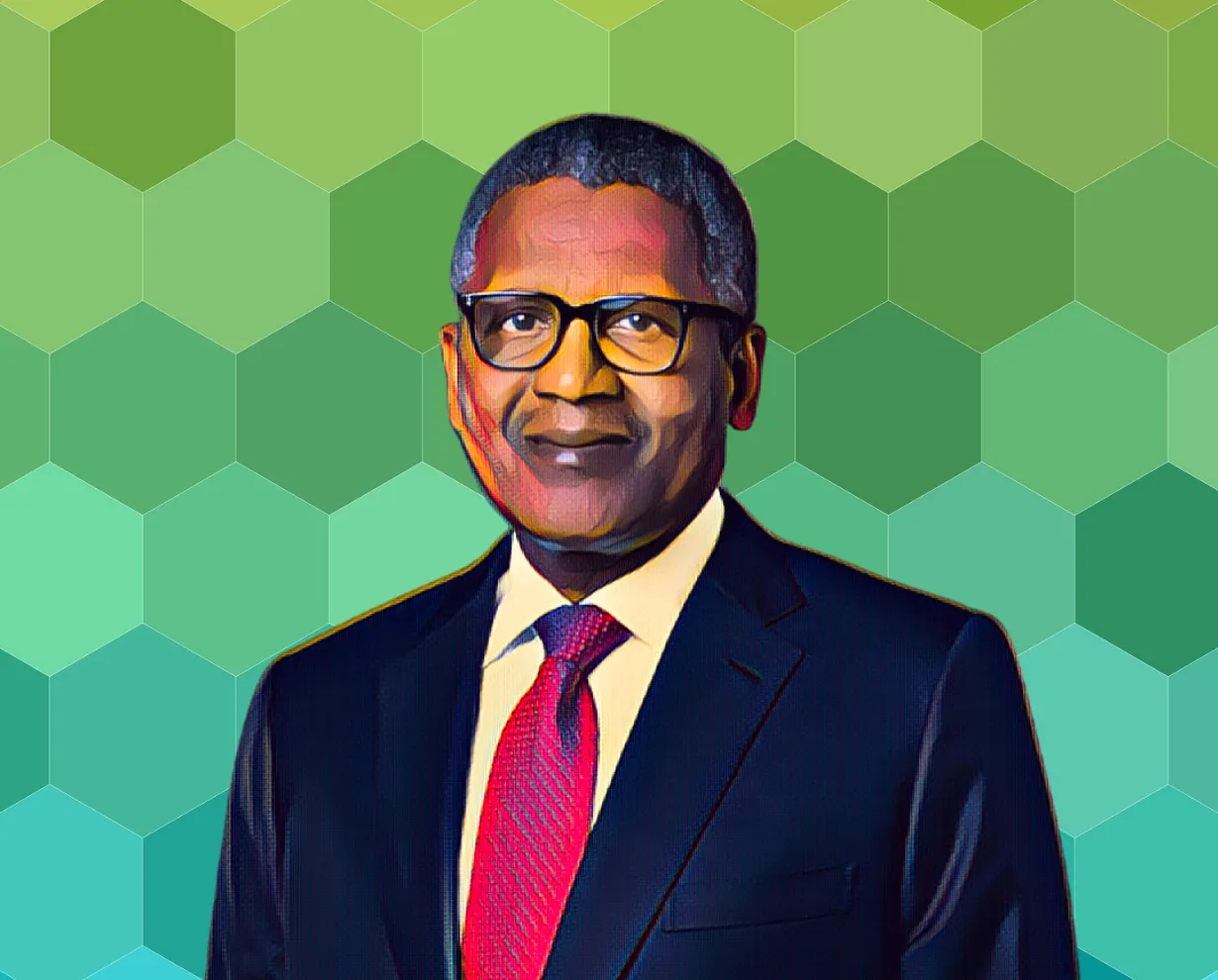
Aliko Dangote, Africa's richest man, is worth $35.3 billion, according to the Bloomberg Billionaires Index as of Aug. 30. Billionaires.Africa believes this number to be conservative.
Bloomberg values Dangote Petroleum Refinery at roughly $20 billion, the figure derived from what the plant cost to build. That is the methodology it applies to private companies with no traded price. Dangote owns 92.3% of it, so the refinery contributes about $18.5 billion to his fortune.
Investors have already priced it differently. A private placement completed in July sold about 6% for $2.5 billion at 35 cents a share, implying an equity value near $41.7 billion. The book was 3.7 times oversubscribed, led by Africa Finance Corporation alongside sovereign-linked funds, development finance institutions and international investors.
The gap between those two valuations is the whole story, and October closes it.
At $41.7 billion, the price investors actually paid, Dangote's stake is worth $38.5 billion. That is $20 billion more than Bloomberg currently counts, and it puts his fortune at roughly $55.3 billion.
At $45 billion, the stake reaches $41.5 billion and the total moves to about $58.4 billion.
At $50 billion, a figure the company has discussed with advisers, the stake is worth $46.2 billion and his fortune approaches $63 billion.
Each of those requires a 57% to 78% increase in his tracked wealth, delivered on a single trading day, without him buying or selling anything.
Reaching $100 billion is a different proposition entirely. It would require the market to value the refinery at about $90 billion, more than twice what investors paid in July and well above where listed refiners of comparable capacity trade.
Why the revaluation is automatic
Once the shares trade, neither Bloomberg nor Forbes has to estimate anything.
Both organisations apply closing market prices to disclosed shareholdings, which is exactly how they already treat his 87.45% of Dangote Cement. The refinery becomes the same kind of asset: a number multiplied by a number.
The rest of his fortune, about $16.8 billion, is already visible in that way. It comprises stakes in Dangote Cement, Dangote Sugar and Nascon, a fertiliser plant valued at $3.02 billion, oil mining licences OML 71 and 72 at about $497 million, Lagos property, Lekki land, aircraft and roughly $744 million in cash.
That mechanical shift is why the trackers have converged this year. Bloomberg had Dangote at $30 billion in October 2025 while Forbes carried him at $26.1 billion, a $4.4 billion gap. By April 2026, Forbes crossed $30.3 billion for the first time while Bloomberg stood at $33.2 billion, the narrowest difference in years. The compression happened as the refinery began producing and both firms started marking it toward what it earns rather than what it cost.
His fortune has risen $5.36 billion this year alone, from just under $30 billion in January, and that is before any of the revaluation.
What is being sold in October
The refinery filed with Nigeria's Securities and Exchange Commission at the beginning of August, targeting a listing on the Nigerian Exchange and a raise of about $5 billion. That would be the largest public offering in African history. A prospectus is expected as early as September, and the final size is not fixed.
Nigeria's entire market capitalisation was roughly $116 billion in early August, so the raise represents more than 4% of the whole exchange.
David Bird, the refinery's chief executive, has called it the people's IPO and said the mandate was to drive Nigerian participation. He has ruled out a foreign listing for at least three years, arguing the company wants a track record of proven production before seeking an overseas valuation. Secondary listings on the Johannesburg exchange and five other African markets are under discussion, with interest reported from South Africa, Kenya, Egypt, Ghana and Rwanda.
Proceeds go toward expanding Lekki from 650,000 barrels a day to 1.4 million, and toward the refinery Dangote is planning in Kenya.
A $1 billion underwriting programme sits behind it, arranged by Marob Strategies and Consulting DIFC and Lilium Capital Group through a vehicle called Pan-African Refinery Investment, a Lilium subsidiary. It splits into a fully funded $600 million private placement tranche, already completed, and a $400 million commitment tied to the IPO that remains conditional on market conditions, regulatory approvals and documentation. The terms of the $600 million tranche, including which investors participated and what stake they took, have not been disclosed.
The variable nobody has answered
All of the arithmetic above assumes Dangote's 92.3% survives the offering intact.
It may not. If the $5 billion raise comes partly from selling his existing shares rather than issuing new ones, his percentage falls and the uplift shrinks. If it is entirely new equity, his stake dilutes but the company holds the cash. The prospectus will settle it, and until it does, every projection carries that qualification.
There is also a case against the valuation. The $41.7 billion the placement implied sits above what listed refiners of comparable capacity trade at internationally. Investors are being asked to accept a premium for the refinery's location, its export reach, the expansion plan and its position in the Nigerian fuel market.
The company's own recent argument cuts the other way. The refinery told the market last week that imported petrol took about 43% of the Nigerian market in July under licences issued by the regulator, and that surplus product has to be exported because it cannot be sold at home. Anyone weighing a $41.7 billion valuation will read that as the company saying its domestic market is not fully available to it.
What is not in dispute is the direction. The refinery has exported 57 million barrels of jet fuel over two years, European buyers have turned to Lagos as conflict disrupted supply through the Strait of Hormuz, and Bloomberg's $20 billion carrying value has looked stale for months.
The intelligence satisfies curiosity. The paid briefings satisfy strategy.
Every Monday, Elite subscribers receive an Investor Memo breaking down the deal, the structure and the positioning behind the week's most consequential African wealth story — the kind of analysis that doesn't appear anywhere else.
Twice a month, a Wealth Intelligence brief profiles a single billionaire's holdings, cash flows and expansion pipeline in detail no public source matches.
→ Executive ($25/mo): Daily newsletter + Deep-Dive Reports
→ Elite ($75/mo): Everything above + Investor Memos + Wealth Intelligence + Quarterly Analyst Briefings
Subscribe now